Thursday, November 26, 2009

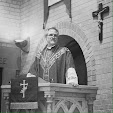
Thanksgiving for Heroes of World Lutheranism


In the face of increasing decadence and apostasy from American and European Christianity - what a blessing to have such heroes within Lutheran church bodies around the world taking a courageous stand for the holy catholic and apostolic faith, the faith of our fathers, the biblical and evangelical faith!

Let us give thanks to God for the witness of these faithful and holy bishops of the churches of the Augsburg Confession! May the Lord grant them long and fruitful ministries as pastors of the Lord's faithful.

HT: Dr. William Tighe and Rev. William Weedon


Moleskine vs. Piccadilly


Pocket notebook users might be interested in this thorough review comparing the more expensive Moleskine with it's almost identical cheaper knock-off imitation made by Piccadilly (the latter of which only seem to be available at Borders).

The Decline: Geography of a Recession


For an extraordinary animated map of the spread of the cancer of the Federal Reserve as manifested by one tragic result of the current boom-bust cycle that causes real pain to real people (thanks to the Fed's paper money and meddling with the market through artificially low interest rates), click here and hit "play."

We will remain on this rollercoaster ride (and likely mostly in a downward spiral) until we abolish the Federal Reserve, fire the Socialist central economic planners, bind the federal government strictly to its constitutional limits, and restore the republic.

Though we face misery now and in the immediate future, this return to sound money and Constitutional liberty will not happen overnight. There is no short-term pain-free fix. We Americans need to be willing to say with Cicero: "Defendi rem publicam adulescens, non deseram senex."

Happy Thanksgiving!


For the Traditionalists (you know who you are) who celebrate the Secular Feast of Thanksgiving with an annual 20-minute musical tribute to one of the strangest Thanksgiving Days of all, this is a must.

Peace and prosperity to all of y'all.

Wednesday, November 25, 2009

Sermon: Thanksgiving Eve

25 November 2009 at Salem Lutheran Church, Gretna, LA

Text: Luke 17:11-19


In the name of + Jesus. Amen.

Dear beloved children of God:

The Church asks us to do something the world does not want us to do – take a little pause. Stop. Relax. Take a breath. Just think.

While the world has been fixated on Christmas for several weeks now – or maybe more accurately, on Commercialmas – we Christians have not even begun our Advent journey to the manger. In fact, we are still rounding out the end of the church year. And although the world considers tomorrow’s holiday to be another commercial bonanza and the preparatory rite of Black Friday’s marketing blitz, the Church sees the Festival of Thanksgiving in a different way.

For we are all like the ten lepers the Lord encountered between Samaria and Galilee. We are all afflicted with mortality, with the disfiguring and corrosive effect of sin. We are all, by our fallen nature, sinful and unclean, leprous outcasts from the Lord’s kingdom. And even if we are in good health, we are still aging. And as the poet once said: “No-one gets out of here alive.”

We don’t like to think about our mortality, and yet it stands there like the elephant in the parlor, the five hundred pound gorilla we all politely ignore. But we can’t brush it off it forever. We need to confront the wretched reality, the truly inconvenient truth. We are sick. We are dying. We live in a fallen world of pain, of disappointment, of loneliness, and of death. And while the world fills our heads with images of perfect families gathered around perfect Christmas trees bursting with material goods and the “perfect” gift for everyone – we know that reality is far from perfect.

And it is into this leprous, imperfect, fallen, sinful, and dying world that our Healer and Savior crosses paths with us on His way to Jerusalem. And though our sins make us stand at a distance, we are drawn to Him who can make us whole.

The Lord Himself closes the gap of that dreadful, deathly distance by coming to us. For He and He alone is the “perfect gift for everyone.” He is born of the virgin. He walks among us, healing us, casting out our demons, and raising us from the dead. He is crucified for us, crying “It is finished!” to rejoin and conjoin anew God and man, and He rises from the dead, blazing the trail for us when we too will finally be rid of the leprosy that infects our flesh. For in our flesh we will rise, in our flesh we will see God, and in our flesh we will be healed and declared righteous by not just any priest, but by the High Priest Himself.

It has been customary during times of harvest – as the fruits of the earth are gathered, as the gifts of God are enjoyed in all their bountiful goodness – that mankind should enjoy a great feast. And this meal is not merely to satisfy our hunger, but also to offer thanksgiving to Him who has withheld nothing from us – not the harvest of the earth we have defiled by our sins, not the bread we have defiled by the leaven of our sins, and not the wine we have defiled by our gluttony and drunkenness. No indeed! Our merciful Lord continues to heap blessings and goodness upon us. He continues to take away our leprous sins, restore our mortal flesh, and bless the fruits of our labors by giving us that which we don’t deserve.

And for us Christians, we who have been visited by the Lord’s most lavish grace, have only one kind of sacrifice to offer. Our priestly sacrifice at the altar of the Most High is not a sacrifice seeking the forgiveness of sins – as though the blood of mortal bulls and goats could remove our trespasses and cure our mortal leprosy. For the Lord Himself is the Priest and the one all-availing Sacrifice, whose blood is shed for us, pleads to the Father for us, and is given to us to drink as part of the great thanksgiving feast of eternity. Our eternal priestly sacrifice is an offering of thanks and praise.

Our thank offering, our Eucharistic offering, our priestly offering of prayer, praise, thanksgiving, of almsgiving and sharing, of love and peace, of the living out of the life of a cured leper – is a life of gratitude. The Samaritan cured of his leprosy, the only one of the ten who returned to fall on His face at Jesus’s feet to give thanks, understood the nature of this sacrifice.

This “foreigner” not only understood how his healing came about, but also understood that the only sacrifice he himself could, or should, offer, is a sacrifice of thanksgiving. And that sacrifice comes in the form of humility, joy, praise, and being in the physical presence of Jesus in order to worship him.

Our Lord Jesus Christ Himself comes into our midst so that we can fall before Him, thanking Him, praising Him, and offering a Eucharistic sacrifice at His altar, eating and drinking the gifts of the Lord’s grace incarnate, all unto the forgiveness of sins and everlasting life.

This, dear brothers and sisters, is why we take a moment, like the Tenth Leper, take a little pause. To stop. To relax. To take a breath. To just think. For in that holy reflection upon what our Lord has done for us, we are led to continually return to the source of our comfort, joy, and life. When we do take the time to meditate on the benefits the Lord gives us, in spite of our unworthiness, we can do nothing else but worship our God in the flesh and to eat the holy Thanksgiving meal that we offer as a feast of victory for our God, but which is even more importantly, a feast offered by our victorious God as a feast of victory for us, for our benefit, for the forgiveness of sins, a victory over the fallen world, over disease, over our mortality, and over evil itself.

And we join the former leper in reverent worship before the Lord Jesus even as we pray:

What shall I render to the Lord for all His benefits to me? I will offer the sacrifice of thanksgiving and will call on the name of the Lord. I will take the cup of salvation and will call on the name of the Lord. I will pay my vows to the Lord now in the presence of all His people, in the courts of the Lord’s house, in the midst of you, O Jerusalem.

“O give thanks unto the Lord, for He is good, and His mercy endures forever.” Amen.

In the name of the Father and of the + Son and of the Holy Spirit. Amen.

Monday, November 23, 2009

A Big (Easy) Day

(left to right: Scaer, Reilly, and Hollywood on Canal Street near Bourbon Street)

There has been a great convergence in the Crescent City these past few days, as the Evangelical Theological Society (ETS), (as well as the Evangelical Philosophical Society (EPS)), and the Society of Biblical Literature (SBL) all decided to meet here this year. Actually, it is by intelligent design that the three meet in the same place every year, and is not the product of fortuitous randomness. And as it was explained to me today, it is a great exercise in ecumenical civility, as for a few days, the Evangelicals consider the SBL-types to be Christian, and the SBL-types consider the Evangelicals to be scholars.

Not knowing which I'm the least bad at (being a Christian or a scholar), I don't belong to either the ETS or the SBL.

But anyway, taking advantage of the fact that there was no school today, the Hollywoods made the trek across the river to meet one of the SBL attendees, the Rev. Dr. Peter J. Scaer. Dr. Scaer also happens to be the first professor I had at Concordia Theological Seminary, as he was my Greek instructor in the Fall of 2000. My class happened to be Dr. Scaer's first class at the seminary as well.

Somehow, we both survived the experience.

I had a few other classes with Professor Scaer, and a year or two later, Mrs. H. and I were most honored to have been able to help him proofread his doctoral dissertation. Professor Scaer invited me to Notre Dame to watch him defend his thesis and watch Prof. Scaer become Dr. Scaer - which was a great privilege for me. His academic adviser was the Rev. Dr. Jerome Neyrey, a prolific New Testament scholar and Jesuit priest. And all this time, we all thought Notre Dame was just a football team...

As hard as it is to imagine, it has already been nine years since Peter taught me my Alphas and Betas, my aorists, participles, and how much I hate the Greek textbook we were using. In deference to the author, I won't say the title nor my opinion that it is probably the worst book I have ever read. Did I type that out loud? Oops.

That sound in the background is Peter clicking his tongue and rolling his eyes, because he likes my writing much better when I avoid controversial topics, such as personal opinions and Christianity.

Although it is a personal opinion, I must say, we had a blast today!

The Hollywoods parked near the Riverwalk and strolled up Canal Street to the lobby of the Renaissance Pere Marquette Hotel, where we met Peter at just after noon. We crossed Canal Street and made a mini-pilgrimage to the Ignatius J. Reilly statue. For some perplexing reason, the iconic clock that used to mark time in front of the D.H. Holmes Department Store was not there today. Tempus fugit? One can only hope the timepiece is being repaired or cleaned, as its perpetual absence would violate the principles of Theology and Geometry. I shall have to write my elected representatives concerning this matter. Oh, there goes my pyloric valve again...

At any rate, we posed for the obligatory photo, and headed back down Canal for lunch at Gordon Biersch on Poydras Street.

It was a wonderful lunch. First, the food. I have learned that in any genre of writing in New Orleans, no matter how serious or frivolous, it must include a brief culinary excursus, presented here in the interest of Theology and Geometry...

Dr. Scaer had the Lump Crab Cake Sandwich with spinach and Cajun remoulade, accompanied by Garlic Fries. Mrs. H. and I shared the Barbecue Chicken Pizza: pulled chicken breast, onion, cilantro and mozzarella over our Märzen barbecue sauce. When he was human, Leonidas H. ate the Chicken Tenders and French fries from the children's menu. I don't believe he was eating while transforming into other creatures from the animal kingdom - which is probably best. Most restaurants frown on him eating the other customers.

The food was excellent, the service top-notch, but the company was the best of all. It was a nice leisurely lunch washed down by beer made on-site at the microbrewery, a relaxing meal with delightful conversation.

After the repast, we trekked over to the French Quarter. While en route to the St. Louis Cathedral, who should we run into but the aforementioned Rev. Dr. Jerome Neyrey, S.J.? After a nice visit, we parted company with Fr. Neyrey and took Peter to see the inside of St. Louis Cathedral, that is, after passing a Lucky Dog cart and a few fortune tellers.

We made the obligatoire visit to Cafe du Monde, drank cafe au lait, and ate beignets while the ubiquitous live music filled the air. Afterward, we strolled along the Mississippi River, as street musicians, performers, and a beautiful old riverboat dotted the landscape of our walk. We cut through the Riverwalk, and headed over to the parking lot, where we got into our sleek and stylish Maserati... okay, okay, it's actually a Toyota mini-van. Why let a little thing like truth get in the way of a good story. This is New Orleans, after all, dawlin'.

We dropped Peter off back at the Pere Marquette and said our goodbyes. From my perspective, it was a much too short visit, though we spent some five hours talking about Theology (without the Geometry), getting caught up on mutual friends, as well as engaging other deep intellectual topics such as cartoon characters.

Peter's flight back to Fort Wayne is at three-something in the morning tonight. The big question is whether to sleep and get up at two-something in the morning, or just stay up. I think the best advice came from a sage New Orleanian, whose proverbial wisdom Peter related in a really well-done New Orleans accent (not an easy thing to do):

"You don't come to the Big Easy to sleep, child!"

(left to right: Scaer and Neyrey on St. Peter Street at Jackson Square)

More pictures here.


Sunday, November 22, 2009

Sermon: Last Sunday (Trinity 27)

22 November 2009 at Salem Lutheran Church, Gretna, LA

Text: Matt 25:1-13 (Isa 65:17-25, 1 Thess 5:1-11)

In the name of + Jesus. Amen.

Dear brothers and sisters in Christ, we have reached the end of yet another church year. We also approach the end of another calendar year. We are all indeed another year older, and we are one year closer to the end of the age and the consummation of eternity.

On the one hand, we don’t like to talk about how things will come to an end. It can be almost depressing when a vacation draws to a close. We are terribly uncomfortable in confronting our own mortality. And the thought of how this world will end may even be the stuff of nightmares and anxiety for many of us.

On the other hand, people flock to movies that graphically depict the end of the world. Many Christians spend most of their time in Scripture trying to figure out hidden prophecies and codes, seeking special knowledge about the end of the age. And even the secular world has jumped on this apocalyptic bandwagon, with books and movies promoting hysteria about the year 2012.

But our Lord Jesus tells us not to worry. He tells us that we do not know when He is coming, so the best policy is to just be ready. He teaches us by way of the parable of the ten young women on their way to a wedding. The five wise virgins made sure their lamps were topped off with oil, so that when the bridegroom came, they would be ready. However, the five foolish virgins were not ready. They chose to sleep instead of remaining vigilant. They allowed other things to take priority. And when the bridegroom came “like a thief in the night,” they were not prepared. Instead of a glorious feast, they found a locked door.

Instead of foolishly poring over the Bible looking for signs and codes, the wise will take heed of our Lord’s call to repent, to “keep awake and be sober,” to watch and pray, to fill our lamps with the oil of God’s Word, and to be ready to follow when our Bridegroom calls.

For we are recipients of the greatest gift of all! We are being refashioned and re-formed, re-created for glory in a new heaven and a new earth. Sin, sickness, and death will be no more, and even better, these “former things shall not be remembered or come into mind.” There shall be no “sound of weeping,” no “cry of distress.” This is what awaits us at the end of our days in this age.

For to us redeemed, dear friends, death does not mark the end of life. Nor does the end of this age mean the end of existence. Quite to the contrary! When sin and death have drawn to a close, we can truly begin to live. And so for the Christian, the end of the world is not something to fear. For we pray for our Lord to come and to “come quickly.” And nor is death to be a source of dread to us who are in Christ. For we know that “whether we are awake or asleep we might live with Him.” For indeed, “God has not destined us for wrath, but to obtain salvation through our Lord Jesus Christ.”

And while the world frets about every sort of imagined disasters, both natural and man-made, such as “climate change,” meteors, melting ice caps, nuclear war, epidemics, food shortages, massive unemployment, alien invasions, and while the world plays to everyone’s fears through movies and books, in colleges and universities, and even in the halls of Congress, our merciful God tells us not to worry.

In fact, in his first letter to the Thessalonians, just after warning these Christians about the end of the world, St. Paul urges them to “encourage one another and build one another up, just as you are doing.”

We are not told to build bomb shelters, or move to the mountains, or pore over Mayan ruins looking for clues nor shift our focus from the Gospel of Jesus Christ revealed in Scripture to looking for esoteric theories of biblical prophecy. We are not to wring our hands and become depressed. We are not to throw away our faith and seek pleasures of the flesh while they can still be had. We are not to stop paying our bills and run around like Chicken Little in fear and dread. No indeed! We are to “encourage one another and build one another up, just as [we] are doing.” And if we aren’t doing that, well, thanks be to God that He is giving us the opportunity to repent and to do just that. And thanks be to God that he has given us encouragement by way of the Parable of the Ten Virgins to show us how to await His coming – with preparation as opposed to panic, with the joy of His impending arrival rather than in sleep and slumber.

And in living in readiness, hearing His Word and partaking of His Sacraments, in devoting ourselves to prayer and praise, in giving thanks and in enjoying the Lord’s goodness, in repenting and in receiving His grace and mercy with joy, we realize that we have nothing to dread about any end – be it the “end of the day” or “the end of our life” or “the end of the world.” For we, the redeemed and the beloved of God, know that such ends are good ends – for the end of the day brings us one day closer to glory, the end of our life brings us into that very glory, and the end of the world brings us into that glory with our resurrected body, living in infinite joy for all eternity.

This is how our ancestors in the faith could walk to their deaths singing hymns. This is what gave the martyrs their courage. This is how St. Paul can be ambivalent toward whether he lived or died, knowing that either way, he was submitting to the Lord’s will and working for the sake of the Kingdom. This is how Christians can sing the ancient hymn of evening prayer that is itself a prayer:

Teach me to live that I may dread
The grave as little as my bed.
Teach me to die that so I may
Rise glorious at the awe-full day.

For we Christians understand that the end of our day, the end of our life, and the end of the world are nothing to fear for us, the Lord’s dear children. And with the ancient church, and especially in these last days, we can continue to pray the magnificent traditional prayer used at the Office of Compline before going to sleep:

Abide with us, Lord, for it is toward evening, and the day is far spent. Abide with us and with Your whole Church. Abide with us at the end of the day, at the end of our life, at the end of the world. Abide with us with Your grace and goodness, with Your holy Word and Sacrament, with Your strength and blessing. Abide with us when the night of affliction and temptation comes upon us, the night of fear and despair, the night when death draws near. Abide with us and with all the faithful, now and forever. Amen.

In the name of the Father and of the + Son and of the Holy Spirit. Amen.

Wednesday, November 18, 2009

Lectio caffea

Mrs. H. and I have stumbled on a wonderfully simple way to incorporate God's Word into our addictive morning caffeination routine.

Our quotidian matinal ritual is for me to prepare a large bowl of cappuccino for each of us. While I am loading the grind into the espresso-maker, preparing the milk, gathering our cups and sugar, and beginning the aromatic process of forcing hot water through the delightful concoction of pulverized naturally-drug-laced roasted beans, Mrs. H. reads aloud the appointed lection from the One Year Bible. And we, being good company synodical types, are using the English Standard Version of the OYB.

As it takes about 15 minutes to make our brew (start to finish), and roughly 20 minutes to read the appointed reading for the day, the time is roughly congruent. It typically allows me to join Mrs. H., sit down, and begin sipping during the New Testament portion of the reading.

Mrs. H. just has to either increase the volume or take a short break during the frothing stage (which refers to my steaming of the milk as opposed to Ezekiel railing against the unrepentant). But it works out just fine.

We started roughly a month ago, and given the consistency of our morning addiction, er, routine, it makes for an easy commitment to keep.

The OYB is a particular lesson plan in which each day's readings are grouped together in 365 daily segments from January 1 to December 31. The readings are not in canonical order in one fell swoop, but comprise a four-part lectio continua (continuous reading) in the form of a reading from the Old Testament, one from the New Testament, one from the Psalms, and a final reading from Proverbs. Within these categories, the readings are in canonical order. Over the course of the year, the Psalms are read through twice.

This is different than the reading plan from the Treasury of Daily Prayer (which we pray separately) - especially insofar as it is a true lectio divina. The readings flow in order from one day to the next. There is no jumping around, and nothing is skipped as a result of the flexibility of the church calendar. These morning readings are, for us, not quite prayer and not quite Bible study - but they are both studious and meditative nonetheless. We figured that the years are going to pass by anyway, and so five years from now we might as well have read the Bible (at least the 66 books of the Protestant Bible) aloud all the way through five times rather than filling the morning air with smalltalk or yawning. We've really come to look forward to our lectio caffea.

If you would like to try to implement such a plan at your home, I do have a few recommendations:
  • Start now. Don't wait until New Year's Day. By starting now (it is November as I write), you can get the routine well-established before your January First plunge into the initial chapters of Genesis and Matthew. Advent is at hand, so this is a good time to make a trial run and get the kinks worked out before the Kalends of January fall upon us.
  • Pick up the little One Year Bible Companion and read it after the appointed daily readings. It is a very brief (maybe 2 minutes) Q&A for each day. They are almost always helpful mini-discussion questions on the text, though once in a while they reflect a theological bias toward neo-evangelicalism. At very least, they get the gears turning and establish a pattern of consideration and reflection.
  • Read out loud, and if possible, make it a group or family activity. By reading silently, it is too easy to zone out or to scan the reading quickly just to make your obligation. Reading aloud to the family makes you slow down, helps insure group accountability, and, as St. Paul tells us, "faith comes by hearing." Even if you are alone, reading aloud makes use of two senses rather than one. And if you have children, you have the added benefit of them hearing the word of God and seeing Mom and Dad reading the Holy Scriptures together every day.
  • Get a small pronunciation guide. Reading names from ancient foreign languages may be awkward at first, but over time, it will become second nature.
This lectio continua will benefit, and in many cases, complement, your use of another daily prayer resource, such as the TDP. Repetition helps to implant the text into the ear, the mind, and the heart. The more familiar we are with Scripture, the more it affects our vocabulary, worldview, and biblical literacy.

Smokers (and vapers) can take advantage of their own brand of ritualism, especially by adding the Holy Scriptures to the morning cup of coffee and smoke. If you're going to have a habit, you might as well sanctify it.

The OYB is available in many versions - including several "Catholic Editions" that includes the deutero-canonical books, though they are segregated into separate additional readings, which is not the most natural way to incorporate these books into one's continuous reading. The Catholic Editions are also very weak translations, such as the politically-correct New Revised Standard Version used in many, if not most, American Roman Catholic churches.

The OYB is available in the KJV to the delight of both "Jack Chick" Fundamentalists and "Smells and Bells" Gottesdiensters. To the chagrin of Deacon Gaba, however, it is not yet available in a Clementine Vulgate edition.

Sunday, November 15, 2009

The Gospel According to Oddball


Sgt. Oddball from Kelly's Heroes is obviously a Christian:

Now, but not yet...

"Now" (Jefferson) is on the right, "Not yet" (Nagin) is on the left. "Life" is the magazine, it is not a prison sentence, though it is tempting...

Yesterday's front page of the New Orleans Times Picayune was devoted to crime. That's not news. But this was apparently a special crooked politician (sorry to be redundant) issue. Sorry to be redundantly redundant, but we're talking about two crooked Louisiana politicians. Republicans might find it further redundantly redundant in that these are two crooked Louisiana Democratic politicians, but thanks to the GOP's own "family values" Senator David Vitter, they are quickly running out of stones to throw across the aisle.

Anyway, first the "Now":

Dollar Bill Jefferson, the Congressman who was discovered with $90k in bribe money in the freezer has been sentenced to 13 years. His defense, interestingly, was that his bribery was a private matter, unrelated to his status as a Congressman, and was, therefore, not a crime. I guess this was the "honorable explanation" he was promising before his trial.

And here is the "not yet":

New Orleans Mayor Ray Nagin has been globetrotting on the public dime. Check out the map! As the prosecutions get closer up the ladder of government in the City of New Orleans, Ray would be smart to be scoping out places to seek asylum. He might also want to make sure his freezer only has ice cream in it, hopefully Dollar Bill has coached him on this.

And, since Dollar Bill is out on bond pending appeal, maybe he and Ray will both be sipping margaritas on foreign soil together. They could take in a Roman Polanski film together or something.

Letting these two crooks flee the country might be a better solution than having the public pay even more in order to incarcerate them. Besides, the other people in prison have enough bad role models.

Sermon Trinity 23

15 November 2009 at Salem Lutheran Church, Gretna, LA

Text: Matt 22:15-22


In the name of + Jesus. Amen.

The Pharisees and the Herodians were clever. Their goal was to kill Jesus. And in the Roman Empire, the best way to do this is to get a person to denounce the emperor or discourage the payment of taxes. And since Jews did not worship the emperor like everyone else, and since nobody likes to pay taxes – especially to an occupying enemy – this was a nifty way to get Jesus on the bad side of the Roman authorities – incidentally, the branch of government that had the death penalty.

And so they put Jesus to the test. “Is it lawful to pay taxes to Caesar or not.” Of course, our Lord knew their question was no question at all, but part of a ruse. “Aware of their malice, [He] said, ‘Why put me to the test, you hypocrites?’” And though He owed them no answer, He used the opportunity to teach us about church and state, about God and mammon, about the Kingdom of God and the Kingdom of Caesar. For we all live under both secular and divine authority, and they are not always in harmony.

They certainly were not in harmony in the Pagan Roman Empire.

And so when they showed Him the coin, He asked them to describe it. And when they pointed out that the denarius had an image of Caesar on it as well as an imperial inscription, our Blessed Lord told them: “render to Caesar the things that are Caesar’s, and to God the things that are God’s.”

His answer was so stunning – not merely in a rhetorical, debate kind of way, but also in its clear exposition of what it means to live under both divine and secular authorities. It is not an either/or situation. But is rather a both/and situation. The Pharisees and the Herodians walked away without the smoking gun they wanted, and yet they “marveled” as the “left Him and went away.”

“Render unto Caesar” has often been repeated by secular authorities to try to bully citizens into a sense of blind obedience about what their government is doing. But the words of Jesus are the Word of God – not the commands of the state. Like the Pharisees and the Herodians, when unbelievers use God’s Word, they are usually repeated out of context, for they are not speaking by enlightenment of the Holy Spirit.

There is a difference between God and Caesar, and there is a difference between the two kingdoms we all live under. The way the state collects taxes is to take that which belongs to you. In the Roman world, the tax collectors were so notoriously dishonest that Jesus Himself uses them as a symbol of those who are outcasts and hated by all. The Roman government didn’t care if tax collectors were thieves – as long as the revenue made its way to the Eternal City.

In our day and age, the federal government has our employers “withhold” a certain percentage of our income to insure compliance. If there is anything left over after we fill out all the paperwork, this remainder is returned to us in the form of a refund that they actually let us keep.

The Kingdom of God works the opposite way. For God owns everything. He is the Creator and Master of all. From the perspective of God, we own nothing. But He shares all with us. He withholds nothing from us. He compels nothing out of us. He does not send tax collectors to take from us. To the contrary, He gives us all things: life, possessions, family, the forgiveness of sins, and an eternal inheritance in His kingdom. And even though we are indebted to Him by virtue of our sins, He forgives the entire debt and pays us infinitely instead, purely by grace.

The state operates under compulsion. The Church operates under love. The state takes under penalty of the law. The Church gives that which has been given to her under the Gospel. The Kingdom of Caesar demands payments for services rendered – all from the fruits of your own labors. The Kingdom of God asks only for grateful thank offerings for that which is given to you freely apart from works.

And yet, in this fallen world, we must render to Caesar – even if under protest, even if grudgingly, even if Caesar is wicked. But in the Lord’s kingdom, we are to be cheerful givers, ever willing to share with our brothers and sisters in Christ from our abilities according to their needs, both in what the Lord has gifted to us as wealth and what He has given us in our skills. Being rich beyond measure in the Lord’s kingdom, we can share and share and never run out of blessings from above.

But notice how the Kingdom of Caesar has distorted “from each according to his abilities to each according to his needs.” This distortion of Holy Scripture was coined by Karl Marx. And it has been used to try to turn our Lord Jesus into a Communist revolutionary or a Fascist dictator. However, the Lord’s Kingdom, unlike the Utopia envisioned by Communism and Socialism, does not operate under compulsion. The Kingdom of God is a kingdom of liberty, not of brutality; a kingdom of life, not of death. The Kingdom of God is a kingdom of grace, not of force.

The Lord has blessed all of us richly. We live in a land where Christians are not persecuted, where we are free to preach and teach, where our churches are not taxed or regulated by Caesar, living in homes that are the envy of most people on the planet. We are blessed with technology and entertainment, free time and the ability to travel. We have choice beyond measure when it comes to food and clothing. And while your Uncle Sam is always there with his hand out, as he has already withheld what you owe him, your Heavenly Father is always ready to give you more. The Son holds His nail-imprinted hand out as well, not to take, but to bless, not to compel with a fist, but to grab your hand and pull you out of the clutches of the evil one.

And all the Lord has ever requested for the work of the Kingdom is not the 30, 40, or 50% that Caesar demands, but rather a paltry 10% for the sake of the Lord’s work.

The earthly government can never spend its billions of dollars in taxes in a way that will please everybody. Many people want the government to run health care, while others do not. Many want government-funded abortions, while others do not. Many want the government to be involved in faith-based initiatives, while others do not. And the political arguments involving these things can divide families, cities, and even churches.

But the Lord’s kingdom, funded by our thankfulness to the Lord, by our denying ourselves a little for the sake of giving to the Lord, goes toward keeping this local parish operating, so that the Word can be preached and the sacraments can be administered; so that people may be taught God’s Word, and so that those with special needs – such as the shut-in and the aged, the sick and the temped, the suffering and the depressed – may receive the spiritual care they need. And if you’re not one of these people, you may well be tomorrow. We also give to support missionary work, so that the Gospel may be preached to all nations, so that others may find the grace of God by which we have been blessed.

We give from our abilities, not because Karl Marx commands us that we must, but because the Lord tenderly invites us as His chosen people to do so. And we receive from the Lord according to our needs not because it is a government entitlement, but rather because we are children of the King and we have the Lord’s promise to deliver to us that which government can’t – the “peace which the world cannot give.”

And unlike that which we give to Caesar, nothing is wasted. Even the widow who placed her two pennies in the poor box did not offer her sacrifice of praise and thanks in vain. For truly she received a reward from the Lord for her love, for serving and trusting Him instead of herself.

Ultimately, that’s the difference between Caesar and God, and between their respective kingdoms. Even the best worldly governments do not love us. Even the most honest and popular of the presidents have not been crucified for us sinful men in order to save us.

And though we may pay taxes patriotically and even with love of country, it is indeed a very different thing to “[render to] God the things that are God’s,” things that are His to begin with, to offer of ourselves without compulsion to our Lord, who has given us all things, who withholds nothing from us, who runs no Internal Revenue Service, who requires no works on our part in order to be saved, and who has made all of us heirs of His kingdom which will have no end. Amen.

In the name of the Father and of the + Son and of the Holy Spirit. Amen.

Saturday, November 14, 2009

"Now, how do you follow a story like that?"

Thursday, November 12, 2009

Nothing says: "We don't really believe this stuff" better than...

...carving a gargoyle of "Darth Vader" on the side of your "cathedral."

If the ones who claim to be Christians don't take their sacred spaces and their faith seriously, why should anyone else? Is it any wonder our churches are emptying in the west?

Read the rest here, where your comments are welcome.

When guns are outlawed...

Here is a sobering warning about tyranny.

This is exactly what happens when governments outlaw firearms, when juries (largely thanks to public school indoctrination) are ignorant of their right to nullify such verdicts (instead of spending 20 minutes to obediently send an innocent man to prison for five years), and when brain-dead bureaucrats are permitted to exercise power.

The people of the UK fell asleep at the switch, and the Americans are not far behind.

This is yet another reminder that one should never make any statement to the police without legal representation.

If there is any sane person in the entire British legal system, this man will be cleared - which is why I'm not optimistic.

Tuesday, November 10, 2009

2012 or Why is This Man Not Smiling?

This poor guy. He is a Mayan Indian elder who is tired of being barraged about the 2012 myth.

Even if the Mayan calendar were accurate, it does not date 2012 as the end of the world. And even if it did, why are some Christians looking to sorcery and false religions to validate their end-times hysteria and ever-changing formulas?

And why is anyone still buying the 1970 pop-prophecy primer The Late Great Planet Earth, when the author was shortly thereafter to publish The 1980s, Countdown to Armageddon? Now, I know the 1980s included spandex, mullets, and Wham! (yikes!), but even with those abominations, the world did not end before Seattle grunge went mainstream. Interestingly, 1980s Countdown is no longer in print (Hmm. I wonder why not...) - but you can get used copies for as low as a penny.

And get ready for the hype to continue thanks to the 2012 movie that is coming out soon.

Make no mistake. Time is moving toward a finite end. The world is running down. We are living in the last days. Jesus will return. But the reality will be far different than the escapists and enthusiasts (who have tried to turn the Bible into a Nicholas Cage movie) imagine and sell to people as genuine Biblical prophecy. There will be no rapture. Jesus will not come back two more times, nor set up a literal thousand year kingdom - which will come to an end. The "last things" have nothing to do with the modern State of Israel. But as we have in the past, we Christians will endure persecution to the end. We will continue to suffer the results of this fallen world until the end of time and the beginning of eternity.

There have been all sorts of ever-changing speculations from the 19th century to the present - especially among American cults and sects - about the exact date of the end of the world. And when their predictions don't materialize, excuses get made, new dates are selected, a few leaders take the fall, new people are found to buy the line, and the great snake-oil show continues - to the detriment of the faith of the many who have been duped.

But we Christians know better than heed such nonsense.

As we Christians have prayed since the first century: "Come, Lord Jesus! Amen."

C.F.W. Walther Quote


"The second type of so-called orthodox Christians, on the contrary, maintains that with Christ, a person can continue to sin safely. These individuals portray Christ as a servant of sin. They, too, have a false Christ in their heart. Christ wants to cover our sins, but He also wants to take them away. He wants to clothe us with His righteousness, but He also wants to take shape in us, to be the High Priest who reconciles us with God, and to be the King who rules over and in us. He suffered and died to atone for our sins, but He also rose and ascended into heaven that He might live in us and we in Him and so we might walk in new life." *God Grant It!* p. 888

HT: The Rev. William Weedon

Sunday, November 08, 2009

Bonerama in Gretna!


Friday night we were treated to yet another free concert as part of our Back to the River Fall Concert series. And what a treat it was! Bonerama played a full set at the Mississippi River levee in Gretna where Huey P. Long Avenue meets the ferry station.

The river is unusually high for this time of year, so the stage was moved from the amphitheater inside the levee itself to a few feet outside the levee. The slight change in venue did nothing to dampen the enthusiasm of the huge crowd, nor did it compromise in any way the genius and musicality of this New Orleans institution.

Bonerama is a jazz/funk/brass/blues/rock ensemble consisting of a guitarist, bass player, keyboardist, drummer, and three singers/trombone players. Yes, three trombonists - hence the name. And man, are these guys good. They're scary good.

You might think such a line-up would come off gimmicky or trite. No way. They are polished musicians who know how to perform and squeeze every decibel of energy and joy from their horns.

I had seen them perform a couple times before at the Gretna Heritage Festival, and was blown away (pun intended). I'm especially fond of their rendition of Whipping Post - which they reprised for us Friday night. But the pinnacle of the evening was when they closed the show with their version of Led Zeppelin's When The Levee Breaks. The above video of a performance at another venue doesn't do the song justice. For a mere $9.95 you can order their latest CD with Levee on it, or download the album here for $4.95.

Levee is the perfect Bonerama song. It has bluesy vocals, tight harmonies, extended musical intricacies, and a section in which the three horns play in uncanny unison (beginning around 8:45 on the above video). Even Leo, who normally can take it or leave it, sat perched on my shoulders mesmerized. After the band finished playing When the Levee Breaks, Leo opined: "That was awesome. I likeded it!"

Of course, brass music, the blues, and songs about levees breaking are quintessentially New Orleans. It is an especially poignant number when performed on the river in plain view of the Superdome, the Crescent City Connection, the ferry running over to the French Quarter, and the skyline of the City. People of all ages, ethnic backgrounds, and walks of life danced, sang, and enjoyed food and, er, beverages together. Children played tag, threw balls, and rolled down the hill.

There is a good number of Bonerama videos on YouTube. You can see them perform such diverse songs as: Helter Skelter, Tchfunkta, The Star Spangled Banner (from Super Bowl 2008), Bap Bap, War Pigs, I'm Walkin', as well as a video of a Letterman appearance. And here is a recent article about them in the Times-Picayune.

And of course, all their albums are for sale here. And no, Father H. Does not get a penny. I just think these guys rock, and I want to share the joy.

I really came to appreciate the remarkable flexibility and sound of the trombone while at the seminary, as the bones were often played with the organ at chapel services and in accompaniment with our Kantorei choir. In fact, I sang in Kantorei with a classmate, a friend, a countryman of my wife and son, and now a pastor in Michigan who opted against a professional musical career and instead answered the call to serve in the parish ministry: the Reverend Jon Bakker. Jon showed up at my ordination at Zion Lutheran Church in Fort Wayne with his trombone in hand and accompanied Michael Hollman on the organ. It was a great ordination gift and a testimony to the Lord's gift of music and musicians.

Sermon: Trinity 22

8 November 2009 at Salem Lutheran Church, Gretna, LA

Text: Matt 18:21-35 (Micah 6:6-8, Phil 1:3-11)


In the name of + Jesus. Amen.

Our Lord’s parable gets to the heart of the Christian faith: the forgiveness of sins.

Satan loves for people to misunderstand Christianity – both inside and outside of the Church. If you ask a hundred people what the point of Christianity is, you’re likely to get one hundred and one different answers.

People often think the main point of Christianity is to get to heaven when they die, or to make us better people, or to create an ethical society. Some believe it is to teach young people morals, or to perform acts of charity, or to provide a social network for adults and children to have fun. Some believe Christianity is mainly a way to learn facts and figures about the Bible or to provide the United States with a worldview in support of the Constitution.

But all of these miss the point.

The point is to rid ourselves, the Church, and the entire world of the one thing that destroys: sin. Sin corrupted the Lord’s perfect creation. Sin makes us live in a world filled with heartache, sickness, and sorrow. Sin is the very reason for death.

In His mercy, God chose to fix us, rather than throw us in the garbage and replace us. It is often cheaper to get something new rather than mend the old – but the latter is the more loving solution – especially when we are the ones in need of repair.

The Christian faith is about God Himself taking up the needle and thread and sowing our broken bodies and souls back together, and in the process, His own hands are pierced, and His own blood from his own broken body is spilled on our broken bodies and souls. We are being repaired of our sins, and sin can only be fixed by forgiveness.

And so the entire point of the faith is for God to take flesh, for God to die for us as the one all-availing sacrifice for the forgiveness of sins, and for the world to be repaired, with all of our sins being forgiven – all by the merciful and nail-scarred hands of God in the flesh.

And though the following are not the goals of Christianity, they are wonderful results of the forgiveness of sins: the hope of eternal life, growing in faith and love, and the cultivation of a worldview based on good rather than evil. Young people are indeed instructed in wisdom, the hungry are fed, and the Body of Christ becomes a community in which to work and play. And in the context of the forgiveness of sins, learning Scripture is a devotion, a meditation, a discipline of prayer, and not the mere acquisition of trivia. And when people in this country and elsewhere turn to the Lord in the forgiveness of sins, we fulfill our mandate to bring the Gospel to all nations, giving us a yet more glorious citizenship in heaven.

Of course, it is all too easy to miss the point, as St. Peter did when he asked our Lord “How often will my brother sin against me, and I forgive him? As many as seven times?”

Peter was seeking a benchmark. For he saw forgiving his brother as a chore, a legalistic hoop to jump through. He wanted to know when he had done enough, in other words, when he could stop doing it.

Our Lord’s reply, “I do not say to you seven times, but seventy times seven” is a way of saying we can never stop. Mathematical purists can interpret the Lord’s reply as “infinity” and young children might see it as a “bezillion billion million” times.

Forgiving sins is not a chore. It is not something for us to put on our to-do list. There is no merit badge after we have completed so many forgivenesses of sins. Rather forgiveness is a way of life. It is a constant practice, because it is what we Christians have had done for us. The Lord’s parable puts it all into perspective.

In His parable, the main character, a servant, owes the king “ten thousand talents” – a comically huge sum. Our Lord might just as well have said “a bezillion billion million dollars.” Of course, the servant can’t even begin to hope to even service the debt, let alone pay off the principal. The king prepares to liquidate the debt by selling the servant and his family. The pitiful servant pleads pathetically: “Have patience with me, and I will pay you everything.”

Of course, this is impossible, but thanks to the king’s “pity” – in the Greek, “being moved by compassion,” the King “released him and forgave him the debt.” The word translated as “released” conveys the sense of being liberated from shackles. Anyone who has ever been in debt knows exactly what our Lord means. “Forgiveness” means setting the scales back to zero from a “bezillion billion million.”

The servant, however, is also himself a creditor. Having been forgiven, being what is essentially the recipient of more money than anyone could ever earn or spend in a lifetime, we would expect the servant to have learned a lesson about pity and compassion, about patience and forgiveness, about humility and empathy. But not so. There is no conversion, no Christmas goose and a trip to Bob Cratchet’s home in this tale.

The unforgiving servant finds a fellow servant who owes him “a hundred denarii” – a large amount of money, but not an unrealistic amount that the ungrateful servant was forgiven. But instead of being moved with compassion, the servant has forgotten the grace shown to him. He becomes greedy to the point of violence. He had his own debtor thrown into prison. A fate shared by the unforgiving servant himself when the master revoked his grace and forgiveness and treated the unforgiving servant in the same way.

And in this short tragedy, our Blessed Lord explains that forgiveness is not a chore, a series of deeds that can be tabulated and benchmarked, but is rather a way of life. It is freely and liberally received and is to be freely and liberally given. He says that forgiveness is to be “from your heart.”

Dear Christians, we have been forgiven a debt of infinity. The deficit has been filled by the blood of Christ – which is of infinite value and is not for sale. We are the servant who has been forgiven the astronomical sum through the Father’s pity and mercy, grace and compassion. We have been released by virtue of the Son’s passion and death. We have been called to “go and do likewise” by the Holy Spirit’s calling, gathering, enlightening, and sanctifying.

We would all do well to meditate on the Ten Commandments, as our sinful nature always seeks to minimize our own sins and maximize those of others – when the Lord’s teaching bids us to do the very opposite. Our own sins are as ten thousand talents, while those who sin against us as a mere hundred denarii. And since we have been forgiven all of our sins, since we have been given a gift too large to number – how can we, the forgiven, justify our own bloodthirst and demands for justice for our own sake?

And so, dear friends, as a result of this great forgiveness, the Christian faith is not a chore, but a labor of love, a life of redemption and service. We make no sacrifice seeking forgiveness, but rather our sacrifices are thank offerings, Eucharistic sacrifices of walking “humbly with your God,” seeking how we can serve the cause of justice and in love of kindness.

Instead of seeking reward, our good works seek only to spread the kingdom, to serve others in need, to offer our thanks to our merciful Lord, and to partake in the Lord’s transformation of creation unto its once and future state of perfection. Our forgiving others a bezillion billion million times, our living a humble life of daily repentance and forgiveness, our giving of mercy even as it has been shown boundlessly to us, are all part and parcel of our Christian life of thanksgiving and praise.

This is the very essence of the Christian faith. All of the impediments to a new heaven and a new earth – all sin, and all the resulting sickness, disease, and death – are being rolled away as we await the consummation of our Lord’s Kingdom. We already have our dwellings assigned in the New Eden, and there is no mortgage, for as we pray in Blessed Martin Luther’s Eucharistic hymn:

All our debt Thou hast paid;
Peace with God once more is made.

O Lord, have mercy!


And it is St. Paul’s prayer that our...

love may abound more and more, with knowledge and all discernment, so that [we] may approve what is excellent, and so be pure and blameless for the day of Christ, filled with the fruit of righteousness that comes through Jesus Christ, to the glory and praise of God.

Amen.

In the name of the Father and of the + Son and of the Holy Spirit. Amen.

Tuesday, November 03, 2009

Workers of the world, unite?


If the president of the United States, his political party, and labor unions don't want to be tainted with Socialism, they might want to stop citing Marxist slogans and advocating a Leninist and Stalinist view of government and private property.

But maybe there is no way to do this without selling out their own philosophy.

Why do Socialists/Communists/Marxists always think it can work here and will never end up being a brutal totalitarian dictatorship that results in not only a loss of liberty, but poverty for all? Look at Marxist track record. Why do American Socialists they think American Socialism will not end up the same way as it has in the former USSR, its former satellites, Cuba, and North Korea? The only reasons China and Vietnam are becoming prosperous is because they are moving away from collectivist economics and moving in the direction of free markets and private property.

Don't these people read? Do they have eyes in their heads?

Is this guy an ignorant fool or a corrupt liar? He has to be one or the other. And if either is true, should the president of the United States be so interested in him?

Sunday, November 01, 2009

Leo the Yellow Jumping Spider on WVUE-8


... as in 8 legs and 8 eyes.

Note: Click on the first little picture ("Halloween in NOLA"), the one with the pic of the guy's face made up like the Joker, and you'll get the little story about the Audubon Insectarium.

Sermon: All Saints

1 November 2009 at Salem Lutheran Church, Gretna, LA

Text: Matt 5:1-12 (Rev 7:2-17, 1 John 3:1-3)


In the name of + Jesus. Amen.

In our Blessed Lord’s Sermon on the Mount, he relates a series of “Blesseds” – known by their Latin name, the Beatitudes. It’s interesting that the Lord sets the fulfillment of almost all of the Beatitudes in the future.

In other words, those who mourn will be comforted. But not yet. The meek shall inherit the earth. But not yet. They who hunger and thirst for righteousness will be satisfied. But not yet. The merciful will find mercy, the pure in heart shall see God, the peacemakers shall be called sons of God. The completion of all of these blessings are set at some future time.

But notice that the Lord never says: “Blessed will be those who mourn, the meek, the hungry and thirsty for righteousness…” The Lord declares that the suffering, those who struggle to remain faithful, those who are beaten and battered by the world and by sin, “are” blessed.

Dear Christians, we are blessed now, even though the fruits of those blessings are “not yet.”

But the Lord does set one of the fruits of the beatitudes in the present: when He says: “Blessed are the poor in spirit” and “blessed are those who are persecuted for righteousness’ sake” for “theirs is,” not “shall be,” but rather “theirs is the kingdom of heaven.”

You, brothers and sisters in Christ Jesus, you possess the kingdom, right now, even in your poverty of spirit and in your being persecuted for the faith. For these are true marks of the Church. No Christian escapes the sinking suspicion that his own spirit is poor, that he has nothing to offer God in himself but a beggar in rags. Likewise, no Christian escapes persecution for the faith from the hostile world, from the hateful devil, and from his own defiled flesh. And yet, the Lord in His mercy does not withhold the kingdom from you.

For as we Lutherans around the world sang either yesterday or last Sunday, even in spite of persecution:

And take they our life,
Goods, fame, child, and wife,
Though these all be gone,
Our vict’ry has been won;
The Kingdom ours remaineth.


The kingdom belongs to the Lord’s Church, the Lord’s redeemed, the Lord’s saints. Not at the end of the world, not after we have become perfect, but now, even in our woeful poverty of spirit and in our shameful persecution.

It may not look like it to our tear-stained eyes, but the kingdom is ours, and it is ours now. And yet we look forward to the day when “God will wipe away every tear from [our] eyes.” For when the beatitudes are completed and brought to fruition by our Blessed Lord, we will be comforted, we will inherit the earth, we will be satisfied, we will receive mercy, we will see God, and we will be called sons of God – even as we partake in our reward in heaven.

These are promises for the future spoken by the mouth of God Himself, and we can rely on Him.

And yet, even in the present, in spite of the fallen world and the mockery of Satan, we are “blessed” in the here and now. It is our kingdom in the here and now. Because Jesus is our King in the here and now.

St. John was given a vision of the Church, that is, of us. In his heavenly and beatific vision, the holy apostle saw “a great multitude that no one could number, from every nation, from all tribes and peoples and languages.” This is the direct result of the Lord’s command to “Go and make disciples of all nations.” The preaching of the twelve has borne fruit and multiplied, and that fruit has likewise borne fruit and multiplied. And so in John’s vision, the Lord’s handpicked twelve has each been multiplied a thousand times over.

And in this vision, the multitudinous Church is no longer weak and poor in spirit and persecuted. In fact, she is victorious. She who formerly sang feebly in many tongues in discord, now eternally sings with one voice in one language and in perfect harmony: “Amen! Blessing and glory and wisdom and thanksgiving and honor and power and might be to our God forever and ever! Amen.”

And yet, this vision of triumph was not always so.

One of the elders asks John the identity of this jubilant choir. He then explains to John that these are they whose robes were formerly dirty in their poverty of spirit. These are they who have “washed their robes and made them white in the blood of the Lamb.” Their poverty of spirit has been replaced by richness beyond imagining. And these are they “coming out of the great tribulation.” For they have been persecuted for righteousness’ sake. Their persecution has been replaced by vindication and comfort.

For on this side of the grave, they were tempted from within and pressured from without to be separated from the Lamb and from their brothers and sisters in the worship of the Lamb. But in eternity, “they are before the throne of God, and serve him day and night in his temple; and he who sits on the throne will shelter them with his presence.”

On this side of the grave, they were subjected to hunger and thirst and torture of the elements. But in eternity, “[t]hey shall hunger no more, neither thirst anymore; the sun shall not strike them, nor any scorching heat.”

And this is how we can say with St. John “See what kind of love the Father has given to us, that we should be called children of God; and so we are.” John does not emphasize that we will be called sons of God (even as our Lord does in His sermon), but points out to us that the reality of being called sons of God in eternity coexists with the reality that we are “children of God” in the here and now.

And this, dear friends, is an act of love on the part of our Father. “See what kind of love the Father has given to us.”

The world who hates the Church and persecutes the Church does so because the world does not know Christ. And this is why the world does not know us either. The world persecutes Christ when it persecutes the Church, for “we shall be like Him.”

And the Church has been poor in spirit, and has suffered persecution for nearly two thousand years. We look upon the Church with the eyes of faith, as an article of faith, for there is no other explanation for the continued existence of this assembly of the poor in spirit and the persecuted. For she clings to the promises of her Bridegroom, looking upon Him not with her tear-filled eyes, but rather with the promise-holding blessed eyes of faith.

And when the kingdom is brought to fulfillment, when our persecution gives way to praise, and when our poverty is exchanged for riches, those same eyes will be wiped dry, for we “shall see God, whom [we] shall see for [ourselves],
and [our] eyes shall behold.” And as we wait for that blessed day:

Now let us worship our Lord and our King,
Joyfully raising our voices to sing;
Praise to the Father, and praise to the Son,
Praise to the Spirit, to God, Three in One.


Amen.

In the name of the Father and of the + Son and of the Holy Spirit. Amen.

Saturday, October 31, 2009

What Lutherans Are and What They Believe

[Note: I don't know who wrote this. I didn't. It was probably written by one of my pastoral predecessors at Salem Lutheran Church. This summary of Lutheran Christianity has been on our website for many years. But I thought it would be an appropriate post for this Feast of the Holy Reformation. +HW]

We are a Catholic, Evangelical, Orthodox Community of disciples of the Lord Jesus Christ.

We are catholic, That is, we believe and teach what has been taught and believed by the Church of Jesus Christ throughout the ages.

We are evangelical. That is, we are centered in the Gospel of Christ. The focal point of our beliefs is the amazing work that God has done on behalf of His people in order to rescue them from sin and all its consequences.

We are orthodox. That is, we are zealous for the right teaching and proclamation of the treasure that Jesus has entrusted to His Church. In this way, we are able to give God the right glory that He so richly deserves.

We are Lutheran. That is, we are identified with the Spirit-led reformer of the 16th century who initiated the rediscovery of the Gospel which had been obscured by centuries of false teaching and traditions.

Our basic beliefs:

We believe, teach and confess that there is one God; the Father, the Son and the Holy Spirit. Apart from this Triune God (One God in three distinct persons) there is no other. Rejected is the error that the True God is any other than the Triune God, or the error that all religions essentially lead to the True God.

We believe, teach and confess that the Second Person of the Trinity, the Lord Jesus Christ is True God, begotten of the Father from eternity and True Man, born of the virgin Mary, by the working of the Holy Spirit. He alone is the Savior of all, whom the Father sent to restore all things. Rejected is the error that Jesus is not God or that He did not accomplish all things necessary for man's salvation.

We believe, teach and confess that at the fall into sin, man's nature became so totally and thoroughly corrupted that he is by nature turned away from God and, from the time of conception, is under God's just condemnation. Rejected is the error that man is somehow morally neutral or that in some regard, he has retained certain powers which may aid him in returning to God.

We believe, teach and confess that salvation is by God's grace alone through faith in the atoning work which the Son accomplished on behalf of all men. Rejected is the error that man may/must somehow aid or cooperate in some way in order to obtain salvation.

We believe, teach and confess that this Christian faith is solely the work of the Holy Spirit, bringing light into man's sin-darkened heart, bringing life to that which was dead, making those who were enemies of God into God's dearly loved children. Rejected is the error that man must open himself, call upon the Lord or invite Him into his heart.

We believe, teach and confess that the Holy Spirit, using His chosen means, namely the Word and the Sacraments, converts, saves, forgives sins and brings to everlasting life. Rejected is the error that the Spirit works apart from means or that man should expect the Spirit in other than His chosen means.

We believe, teach and confess that Jesus has established His Holy Christian Church to preach the Word and administer the Sacraments, so that all might become disciples of the Lord. Rejected is the error that Jesus established His Church with powers other than the preaching of the Gospel and making disciples of all nations.

We believe, teach and confess that the good works that man does is a result of the good that the Holy Spirit has placed within him. They are the fruit of a living faith. Rejected is the error that man may somehow do good works apart from faith or that they contribute toward faith, or in aiding to gaining salvation.

We believe, teach and confess that at the Last Day, all men will rise again, and that those who are believers in Jesus will receive everlasting life, and that those who reject Jesus will receive everlasting condemnation. Rejected is the error that those who do not have faith in Jesus can somehow receive eternal life or that there is no everlasting condemnation for the evil.

Thursday, October 29, 2009

Is Rush Reading Fr. H.?

On October 20, in comments to this post, Fr. Hollywood wrote:
"For they [the Republican Party] would rather have a liberal Republican at the helm of California than a conservative non-Republican, or a liberal who does not have the GOP Party label.

The GOP's mission is not conservatism. Its mission is the GOP - whether liberal, conservative, or moderate. More accurately, its mission is victory for the party - and there seems to be no limit to the cost. The same is true with the Democrat Party.

The party labels are just that: labels....

In fact, I believe you will see the [Republican] party push for a 'bigger tent.' There are already voices within the party calling for a 'broader base.' In the aftermath of the 2008 trouncing, I do think 'strategists' will move the party further to the left. I hope I'm wrong about this.

The GOP leadership will drop the 'Christian right' like ballast if (and when) the pundits determine they are an impediment to victory....

I don't think the GOP has been conservative since Goldwater. The Republican Party is too pragmatic and leftist. I believe we have two moderate parties that both favor big government and believe in working around the constitution.

I just don't find the two majors to be very different from one another at all."

My dear friend and colleague, loyal Republican and Rush Limbaugh listener "Peter," wasn't too happy with my remarks. However, one week later to the very day, Rush Limbaugh said:

"They have a death wish. The Republican Party has a death wish. Gallup: 40 percent of Americans now say they are conservative, 20 percent say they're liberal, 36 percent say they're moderates. And of those three groups, which one is being ignored – not just ignored – which one is being attacked by the Republican Party? The conservatives!
It's worse than I thought. I thought this was just based on elitism and northeast moderate liberalism, and embarrassment of the people that the social issues attract to the party. But now it's just plain stupidity...

The Republican Party, as constituted is as dangerous to this country as the Democrat Party is. 'But Rush, party loyalty is party loyalty, and the local Republican committee up there has endorsed [left-wing Republican] Scozzafava.' So? I'm saying the two parties are the same. I guess I need to amend it a little bit, but, man, when I saw that they were running ads, as I say, ruined two hours of my day."

Is Rush Limbaugh secretly reading Father Hollywood and saying "Mega-dittoes"? If so, I want to encourage Rush to keep reading, and while he's poring over his advanced gnesio- and paleo-conservative studies, he should also go after some truly free-market economics from the Austrian School, and learn what real constitutional conservatism is. And considering that he does hail from Missouri, maybe Rush could even be influenced to become a Traditionalist Lutheran and pay for that seminary library they're building in Fort Wayne with a single swipe of the debit card.

I'll bet Dr. Wenthe could finally get that espresso bar...


Tuesday, October 27, 2009

Well, thank God this is not an LCMS Ablaze!(tm) project...

Y'all, the Halloween Book Burning is still on!

The happy conflagration will include setting ablaze "Satan's music" (like heavy metal, rap, country, and "soft and easy" - wait, what?). They will be torching "Satan's Bibles" (meaning all non-KJV English versions, keep your ESV indoors on Halloween!), and also "Satan's books" written by "heretics" (like Billy Graham and Charles Swindoll) will all be burned by Amazing Grace Baptist Church in North Carolina. Maybe they should call it Ablazing Grace, but it looks like the Lutherans beat them to it. Sigh.

But don't show up without an invite! The Burnin' is "by invitation only." There is no talk of crosses being lit, but rest assured, there will be "great preaching and singing" (I can just imagine...) and they "will be serving fried chicken, and all the sides." Really? "All" the sides? What a blowout! Come for the bonfire, stay for the chicken. My invite must still be on the way. I'll just keep checking the mail.

I don't know about you, but whatever web design manual that was used by their webmaster to put their site together really needs to be burned. In fact, my eyes are burning. There's more red on that page than on the faculty of Berkeley.

And even though we Lutherans have been known to do a little book burnin' ourselves, I cannot help but sing "thousand thousand thanks are due" that this is not an LCMS church activity or a district Ablaze!(tm) publicity stunt.

Deo gratias, y'all!

"Leveraging the Flu Pandemic" or "Flu Servant Evangelism"

This just in from a certain District Office of the LCMS (really, no kidding)


Leveraging the Flu Pandemic... Getting the Word Out

Greetings! I am passing along this idea for consideration by your school to get the word out about your school and show a love concern for people. I believe this is a product people would use and remember! This is an idea passed along by [name deleted] of the [name deleted] District. This can be part of marketing/outreach!

Flu Servant Evangelism
We know that a small act of kindness might nudge a person closer to God, often in a profound way as it builds a bridge for the person to receive a touch of love from God. Why not confront the current influenza outbreak by offering people of your community a touch of God's love in a very practical way?

The [name deleted] District (read that, "[name deleted]") is encouraging our congregations and schools to "leverage" the current flu outbreak by involving themselves in a servant evangelism idea using the free distribution of bottles of hand sanitizer to local businesses.

We have designed labels for congregations and schools to download off of our website and to affix to one dollar bottles of hand sanitizer (Dollar Store, Dollar Tree, etc) to be distributed to the local business in their area...and in so doing, to maybe touch someone with the love of Christ.

Schools and congregations can design their own labels, or "stock" PDF copies of the labels, designed for either a congregation or for a school, are available for download on our website at http://lcmsed.org/a/whatsNew.php. These labels are sized to fit Avery shipping labels, #5264.

“Small Things Done with Great Love Will Change the World” as we live the Jesus-style life of noticing and responding to those around us with kindness, love and generosity.


Daniel Hannan Reviews Atlas Shrugged

I concur with this review of the 1957 novel Atlas Shrugged by the Russian-born American novelist and political philosopher Ayn Rand.

The philosophy of Ayn Rand (developed during her own childhood nightmare of living through the Bolshevik Revolution) is a complete repudiation of Communism and of all forms of collectivism. Rand makes a powerful moral argument for capitalism and for individual freedom.

The downside of her philosophy (which she called Objectivism) is that it posits that all altruism is evil - even when done completely privately without government involvement or compulsion. She is also fiercely Atheistic, and denounces all religion as evil.

And yet even with these caveats (along with her followers' cultishness and her own shameful conduct of her sad personal life which does not serve to vindicate her philosophy), there is much to be learned from Rand. Her essays are better than her novels - though even Atlas Shrugged is brilliant in parts. The premise is unique and promising (the producers and thinkers of society find a way to "go on strike"), heroic (Rand's good guys and bad guys are not hard to figure out, to say the least), and the book's rhetorical device, "Who Is John Galt?", has been iconic among conservative thinkers around the world for half a century. However, as a novel, the well-conceived plot falls flat on its face. The book is far too long, and Rand's storytelling is dreadfully wooden; her characters are simply too robotic to be realistic.

Nevertheless, I recommend it.

It has had a profound effect on American conservatism and libertarianism. It is a work of literature of the same genre as 1984, Fahrenheit 451, and Brave New World. It forces us to rethink our premises about the "common good" and the role of government. Even Christian conservatives and/or libertarians can draw from Rand - in spite of the bad storytelling and the hard edges to her philosophy. And I agree with Hannan that a film version might be just what the doctor ordered to clean up Rand's sloppiness and verbosity.

And as an aside, I find it a breath of fresh air to find a politician like Daniel Hannan, a thinking conservative who can truly write, witty, brilliant, at times fiercely independent, and unashamed to mix Latin, French, and American slang in a well-crafted book review.

If more Congresses and Parliaments around the world had more men like Daniel Hannan, perhaps we could afford to ignore Ayn Rand and not heed the warnings in books like Atlas Shrugged.

Monday, October 26, 2009

More conservative group non-think

Being in my car for a few minutes today, I listened to the local conservative talk station. They were addressing this story about a hotel owner in New Mexico who told his Hispanic employees to Anglicize their names while on the job. He also told them they were not permitted to speak Spanish in his presence, out of (get this!) fear that they would be talking about him. This former Marine was afraid his employees would say something bad about him. Gads.

The callers and the host of the talk show were shocked (shocked!) that anyone had a problem with an employer telling people to change their names - especially those of a different ethnic background. I mean, who could imagine such a thing?

I agree that the man can do what he wants in his business. If he wants his employees to wear monkey suits and speak only in Pig Latin, that's his business. But it is also stupid. It is also the right of the people in the community to express their displeasure. And once a business has the reputation for ethnic stupidity, it's not easy to recover from that. A supposedly smart businessman should know better. Lord have mercy, the guy's even from Texas! Can he really be shocked (shocked!) that his Hispanic employees don't want to change their names? Gads.

But what really amazed me was the lockstep agreement from the callers on the radio show. Not a single one of them could even see the point of the employees and of those who disagree with the owner. They were utterly indignant, and their explanations all had to do with "liberal" this and "liberal" that, as well as complaints about illegal immigration. Of course, if the owner is hiring illegals, he is the one who should be getting the brunt from the conservative callers. If this is the case, he is an enabler. But if these are legal workers, especially if they are American citizens, than the illegal alien issue (which is a big issue) is a moot point in this case.

Is this rocket science? Gads.

This "group non-think" is the problem with the two-dimensional labels that pass for social, cultural, and political discourse these days - along with the virtual brainwashing done by talk radio programs. It is as though people get their marching orders and talking points on the morning talk programs, and then call and parrot those same spoon-fed opinions on the afternoon shows.

And, of course, the fact that the owner is a former Marine made him all the more right. Gads.

But how would these same conservative, patriotic American callers feel if their sons and daughters were working for a left-wing version of the hotel owner? What if their kids' boss at McDonald's demanded that they change their names to "Kennedy" or "Clinton" or "Hillary" or "Obama"? What if a worker named Joe was told by his boss that his new name will be "Jose"? What if a Christian kid were given the business name of "Muhammed?"

And considering that the Chinese now own us, how long before hotel owners will be demanding Americans change their names to those easier for Mandarins and Cantonese to pronounce? So, your names are Bill or Jane? Not any more, Chang and Xie. If you don't like it, get a job somewhere else. So, how would that go over on the conservative talk circuit?

Do you think these same callers would be so keen on business owners demanding names to be changed if the shoe were on the other foot?

Peoples' names are peoples' names. I'm not a big fan of some of the monikers young parents come up with these days. But that's what their kids are called. What kind of a boob refuses to call someone by his name? And how myopic of an American businessman in the Southwest to go after Hispanic names! Hello? Are all the pistons firing? Gads.

I can just imagine this guy coming here and telling the iconic Monsieurs Boudreaux and Thibodeaux that they have to Anglicize their names. I think there would be some really happy gators at the Bayou Sauvage National Wildlife Refuge as a result. Bon temps!

And like it or not, we do have people from ethnic backgrounds that make use of names (or even sounds!) that we of the more WASPy persuasion are unfamiliar with. So, roll with it. What's the big deal? Just learn the names! He expects his employees to learn his, doesn't he? People all over the world in metropolitan places deal with this all the time, and have for millennia. And yes, some people voluntarily do Anglicize their names when they move to America. That's fine, if that's what they want to do. Ordering them to do it or lose their jobs is just plain dumb. It even comes across as anti-American. I thought we stood for individual liberty. Imagine what a control freak you must be to tell grown men and women to change their names. Employment is not exactly the same thing as slavery. These are people, not dogs, after all.

But what's worse is the brainwashing job that has made a good number (but certainly not all) conservatives to be virtual clones of one another, seldom veering from the approved party line. Those who disagree in any jot or tittle are looked at askance and their conservative credentials (or their patriotism) are called into question. But it should be that conservatives can think for themselves, disagree, debate, discuss, and learn from the dialogue - with their opponents and with one another. We often accuse the left of not being able to think rationally, and yet conservatism has become so conformist and lockstep (thanks largely to Big Talk Radio) that we might as well issue everyone a little red book of conservative radio talking points and wear matching uniforms. Gads.

Gasteracantha!

We have one of these happy-looking critters (Gasteracantha cancriformis) hanging off of our orange tree, just outside our bedroom window. Leo identified it from his field guide, and came to show us.

This particular one is in the yard of a parishioner, who graciously snapped this magnificent picture and e-mailed it for Leo's enjoyment - one of the best spider pictures I have ever seen! Our tenant looks very similar, right down to the phony yellow smiley face.

They spin huge orb webs with an interesting feature - some of the threads have decorations (stabilimenta) in them, which serve like warning lights on tall towers to warn airplanes. Birds avoid flying into the web by seeing the decorative elements.

And we're supposed to believe this ability (not to mention the magnificently designed creature itself) evolved by random chance.

If you're really amused by spider pictures, you might enjoy LOL Spiders - though there is some PG-13 language on some of the pictures.

Substitionary Atonement


My friend and chief sermon critic "Theophilus" wrote (in a comment in response to my sermon on the Feast of St. Luke):
"Very late, in the 12th century, St. Anselm formulated his doctrine of substitution atonement. He too depicted God as a wrathful judge who had to punish someone, namely Jesus, before he could forgive sins. This false doctrine has become the chief doctrine within Christianity. Often, as I make my way from church to church on Sunday mornings, I hear a lot of religious talk from the pulpits. But, invariably, the preacher will end his sermon with a brief reminder of the doctrine of substitution atonement, thinking that he has thereby given his people the gospel in a nut shell. I do not think so. Often, over the years, I have heard Christians say, “I can sin all I want to, for all my future sins have already been punished on the cross of Christ.” What a terrible distortion! It is time to reject that doctrine and to return to God’s own self-definition. He is merciful and gracious, faithful and forgiving by name and character. He forgives sins FOR HIS NAME’S SAKE. This truly is good news."
Theophilus has compared his view of Christianity to that of Thomas Jefferson, who rejected all of the miracles of the Bible as metaphors. However, Theophilus doesn't reject all supernatural occurrences - such as the resurrection of our Lord. He does, however, believe that most (if not all) of Jesus's miracles are metaphors for what he calls the "covenant-gospel message." Theophilus argues that the doctrine of the Trinity, for instance, is unbiblical, and was invented and dogmatized by the institutional Church in the 4th century.

Anyway, that's just a bit of background. I do want to briefly address the substitutionary atonement - even as I have already addressed his concerns about the doctrine of the Trinity and the divinity of our Blessed Lord.

To claim that the doctrine of the substitutionary atonement was "formulated" by St. Anselm in the late 12th century (and implying that this was not taught in Scripture nor by the church fathers before Anselm) is the equivalent fallacy of concluding that gravity did not exist prior to Isaac Newton in the 17th century. Newton studied, theorized, researched, and systematized our knowledge of gravity, but he certainly didn't "formulate" it. Nor was he ever the first to discover or reflect on it.

Theophilus's view of Christianity boils down to little more than the fact that Jesus is a Really Nice Guy. Theophilus does not believe Jesus is God. Nor does he believe Jesus's death on the cross paid sacrificially for the sins of the world (though he does believe Jesus rose from the dead and still lives today). Of course, such a view makes Jesus's death on the cross a defeat rather than a victory, and makes St. Paul's declaration "We preach Christ crucified" (1 Cor 1:23) seem rather pointless.

The substitionary atonement has two parts: "atonement" - which involves making restitution for sin, while the "substitutionary" element deals with the fact that the sacrifice is offered on behalf of the sinner as a substitute or proxy.

"Atonement" is the English translation of the Hebrew word kapporet and its Greek equivalents are hilasmos and hilasterion. In the Old Testament, kapporet especially points us to the mercy seat of the Ark of the Covenant and the Day of the Atonement (Lev 16).

On this day, the high priest would enter the Most Holy Place carrying blood from the sin offering: "Aaron shall offer the bull as a sin offering for himself and shall make atonement for himself and his house" (Lev 16:6). Here we see the bull acting as the proxy and the sacrifice to cover the sins of the priest and his family. He also makes another offering, a "goat of the sin offering that is for the people" (Lev 16:15) and he would carry its blood behind the veil to where God was present, and sprinkle the blood on the mercy seat of the Ark of the Covenant as an offering. There was also the sacrifice of another goat: "Aaron shall lay both hands on the head of the live goat, and confess over it all the iniquities of the people of Israel, and all their transgressions, all their sins. And he shall put them on the head of the goat and send it away into the wilderness by the hand of a man who is in readiness. The goat shall bear all their iniquities on itself to a remote area, and he shall let the goat go free in the wilderness" (Lev 16:21-22). The "scapegoat" was left to die as a substitutionary atonement, bearing by proxy the sins of the people.

The Book of Hebrews points us back to this sacrificial system of substitutionary atonement of the Old Testament as types, or foreshadowings, of the coming of our Lord Jesus Christ ("but a shadow of the good things to come instead of the true form of these realities" Heb 10:1). For "Jesus is the guarantor of a better covenant.... [who] holds his priesthood permanently, because he continues forever (Heb 7:22-23). And yet, this "new and improved" High Priest is also Himself the offering, the substitutionary atonement: "He has no need, like those high priests, to offer sacrifices daily, first for his own sins and then for those of the people, since he did this once for all when he offered up himself" (Heb 7:27, emphasis added). This is the very definition of a substitionary atonement.

This "once for all" offering is elaborated upon in Hebrews 10. The entire chapter is an articulation of the sacrifice of Jesus as atonement for the sins of all. For "He abolished the first in order to establish the second. And by what will we have been sanctified through the offering of the body of Jesus Christ once for all. And every priest stands daily at his service, offering repeatedly the same sacrifices, which can never take away sins. But when Christ had offered for all time a single sacrifice for sins, he sat down at the right hand of God" (Heb 10:10-12).

Heb 9:11-28 is filled with the details of Christ's death as the once-for-all sacrifice, the substitutionary atonement of the New Covenant. You can click the link here to read the entire passage. Here are a few key excepts (emphasis added):
  • "he entered once for all into the holy places, not by means of the blood of goats and calves but by means of his own blood, thus securing an eternal redemption" (Heb 9:12).
  • "how much more will the blood of Christ, who through the eternal Spirit offered himself without blemish to God, purify our conscience from dead works to serve the living God. (Heb 9:14).
  • "without the shedding of blood there is no forgiveness of sins" (Heb 9:22).
  • "But as it is, he has appeared once for all at the end of the ages to put away sin by the sacrifice of himself" (Heb 9:26).
  • "so Christ, having been offered once to bear the sins of many, will appear a second time, not to deal with sin but to save those who are eagerly waiting for him (Heb 9:28).
The substitutionary atonement of Christ was prophesied 700 years prior by Isaiah: "Surely he has born our griefs and carried our sorrows; yet we esteemed him stricken, smitten by God, and afflicted. He was wounded for our transgressions; he was crushed for our iniquities; upon him was the chastisement that brought us peace, and with his stripes we are healed" (Isa 53:4-5 emphasis added). The flow of the pronouns in this prophecy leave no doubt of the substitutionary nature of the Messiah's sacrifice on the cross.

St. John writes: "We have an advocate with the Father, Jesus Christ the righteous. He is the propitiation (hilasmos - see above) for our sins, and not for ours only, but also for the sins of the whole world" (1 John 2:1-2). It is no accident that the Apostle uses this phrase "sins of the whole world," as he recorded St. John the Baptist's words upon presenting Jesus: "Behold, the Lamb of God, who takes away the sin of the world!" (John 1:29). The "Lamb" is an obvious reference to the concept of sacrifice. The fact that this sacrifice is being applied to the "whole world" is what makes the atonement substitutionary. John also reports the eternal song of the saints in heaven: "And they sang a new song, saying, "Worthy are you to take the scroll and to open its seals, for you were slain, and by your blood you ransomed people for God from every tribe and language and people and nation" (Rev 5:9) - emphasis added.

St Paul writes: "that is, in Christ God was reconciling the world to himself, not counting their trespasses against them, and entrusting to us the message of reconciliation" (2 Cor 5:19). "For there is one God, and there is one mediator between God and men, the man Christ Jesus, who gave himself as a ransom for all, which is the testimony given at the proper time (1 Tim 2:5-6). "and through him to reconcile to himself all things, whether on earth or in heaven, making peace by the blood of his cross. And you, who once were alienated and hostile in mind, doing evil deeds, he has now reconciled in his body of flesh by his death, in order to present you holy and blameless and above reproach before him (Col 1:20-22). St. Paul explicitly ties Jesus to the Passover sacrifice: "Cleanse out the old leaven that you may be a new lump, as you really are unleavened. For Christ, our Passover lamb, has been sacrificed (1 Cor 5:7). "Christ redeemed us from the curse of the law by becoming a curse for us—for it is written, "Cursed is everyone who is hanged on a tree" (Gal 3:13) - emphasis added.

St. Matthew, like John and Paul, also (quoting our Blessed Lord Himself) describes Jesus as a "ransom" (lutron) - which is a substitutionary payment: "even as the Son of Man came not to be served but to serve, and to give his life as a ransom for many (Matt 20:28). St. Luke explains the the payment made in this ransom by citing St. Paul's exhortation to the bishops of Ephesus: "Pay careful attention to yourselves and to all the flock, in which the Holy Spirit has made you overseers (episkopous), to care for the church of God, which he obtained with his own blood (Acts 20:28 emphasis added).

The Apostle Peter likewise refers to the substitutionary atonment in his two epistles: "But false prophets also arose among the people, just as there will be false teachers among you, who will secretly bring in destructive heresies, even denying the Master who bought them, bringing upon themselves swift destruction" (2 Peter 2:1). "knowing that you were ransomed from the futile ways inherited from your forefathers, not with perishable things such as silver or gold, but with the precious blood of Christ, like that of a lamb without blemish or spot" (1 Pet 18-19). The substitutionary nature of the Lord's atonement is emphasized by St Peter: "For Christ also suffered once for sins, the righteous for the unrighteous, (1 Pet 3:18) - emphasis added.

So, the substitutionary atonement is clearly taugh in both Old and New Testaments.


It was also taught by the Church fathers well before the 325 council of Nicea. Here are a few examples from the Ante-Nicene Fathers, cited in the Dictionary of Early Christian Beliefs, pp. 41-48 (with citations from the Ante-Nicene Fathers, vols 1-10):

"Because of the love He had for us, Jesus Christ our Lord gave His blood for us by the will of God. He gave His flesh for our flesh, and His soul for our souls." - Clement of Rome, 1 Corinthians, ANF 1:18, c 96 AD.

"The Father Himself placed upon Christ the burden of our iniquities. He gave His own Son as a ransom for us: the holy one for the transgressors, the blameless One for the wicked.... For what other thing was capable of covering our sins than His righteousness?... O sweet exchange! O unsearchable operation! O benefits surpassing all expectation! That the wickedness of many should be hid in a single righteous One, and that the righteousness of One should justify many transgressors." - Mathetes, Letter to Diognetus, ANF 1:28, c 125-200 AD.

"Jesus Christ 'bore our sins in His own body on the tree.'" - Polycarp, 1 Philippians, ANF 1:35, c 135 AD.

"The whole human race was found to be under a curse.... The Father of all wished His Christ, for the whole human family, to take upon Him the curses of all, knowing that after He had been crucified and was dead, He would raise Him up.... His Father wished Him to suffer this, in order that by His stripes, the human race might be healed." - Justin Martyr, Dialogue With Trypho, ANF1:247, c 160 AD.

"In place of Isaac the just, a ram appeared for slaughter, in order that Isaac might be liberated from his bonds. The slaughter of this animal redeemed Isaac from death. In like manner, the Lord, being slain, saved us. Being bound, He loosed us. Being sacrificed, He redeemed us. - Melito, Remains of the Second and Third Centuries, ANF 8:759, c 170 AD.

"Abraham, according to his faith, followed the command of the Word of God. With a ready mind, he delivered up, as a sacrifice to God, his only-begotten and beloved son. This was to demonstrate that God also might be pleased to offer up for all his seed His own beloved and only-begotten Son, as a sacrifice for our redemption." - Irenaeus, Against Heresies, ANF 1:467, c 180 AD.

"Redeeming us by His own blood in a manner of harmony with reason, He gave Himself as a redemption for those who had been led into captivity." Irenaeus, Against Heresies, ANF 1:527, c 180 AD.

"In this manner, the Lord has redeemed us through His own blood, giving His soul for our souls, and His flesh for our flesh." - Irenaeus, Against Heresies, ANF 1:527, c 180 AD.

"For you, I [Christ] contended with Death, and I paid your death, which you owed for your former sins and your unbelief towards God." - Clement of Alexandria, Who is the Rich Man That Shall Be Saved?, ANF 2:598, c 195 AD.

"You have already been ransomed by Christ - and that at a great price!" - Tertullian, The Chaplet, ANF 3:101, c 211 AD.

"A man could not give anything as an exchange for his own life, but God gave an exchange for the life of us all, 'the precious blood of Christ Jesus.' Accordingly, 'we were bought with a price,' 'having been redeemed, not with corruptible things as silver or gold, but with precious blood." - Origin, Commentary on Matthew, ANF 9:465, c 245 AD.

"The Son also gave Himself to death for us, so that He was delivered up - not only by the Father - but also by Himself." - Origin, Commentary on Matthew, ANF 9:479, c 245 AD.

"For man's salvation, He was made man in order to overcome death and to set all men free. In that He offered Himself as a victim to the Father on our behalf, He was called a calf." - Victorinus, Commentary on the Apocalypse, ANF 7:348, c 280 AD.


There are many more citations of ante-Nicene fathers on the atonement listed in the Dictionary of Early Christian Beliefs, pp. 41-48. These are just a smattering. These demonstrate that the clear scriptural interpretation of the substitutionary atonement of Christ was understood by the early Church from the apostolic fathers on. St. Anselm did not pull this doctrine out of a hat, but rather received it from the early fathers who in turn received it from the Word of God.

This is why we continue to "preach Christ crucified," and not merely Christ the Nice Guy, but rather "a stumbling block to Jews and folly to Gentiles, but to those who are called, both Jews and Greeks, Christ the power of God and the wisdom of God. For the foolishness of God is wiser than men, and the weakness of God is stronger than men" (1 Cor 1:23-25).

Sunday, October 25, 2009

Sermon: Reformation (transferred)


25 Oct 2009 at Salem Lutheran Church, Gretna, LA

Text: Rom 3:19-28


In the name of + Jesus. Amen.

Some things are just not for sale, nor should they be. Love is one such thing.

Can you imagine having to pay your mother to love you? Can you imagine having to perform a checklist of tasks to merit your father’s love?

It’s easy to forget that this is the very issue that sparked the Reformation that we call to mind on this day.

Today commemorates the anniversary of an event that set in motion a series of happenings that nobody saw coming. Martin Luther’s ordinary notice posted on the church door – the 16th century equivalent of the blog post – resulted in an extraordinary playing out of history: heated discussions that led to accusations flying in both directions, mutual excommunications, a restoration of the preaching of the Gospel, death and bloodshed, a renewed emphasis on God’s Word, people being burned at the stake, worship in the language of the people, military conquest and oppression, a renewal of Christian family life, and a western Christian Church that has become Humpty Dumpty never to be put together again.

The Reformation was, in short, a mixed blessing of nobody’s intention. And yet it was a necessary blessing for the sake of the Church and of the Good News of Jesus Christ.

But in the midst of all the doctrinal disputes, the history, the debates, the personalities, the political tug-of-war, and all the hype on both sides, the issue boils down to the question of whether or not love is for sale.

Before he was Dr. Luther the famous theologian, he was Father Martin, the obscure monk and priest who found no love, neither from His heavenly Father nor from his churchly mother. The God to whom he devoted himself required the impossible to be done, and Luther’s failure to do so resulted in what seemed to be unrequited love. Such a view of the Christian life is dreary and depressing, anything but good news. Furthermore, the Church into whose bosom Luther fled for comfort and refuge, demanded money up front before any love, any grace, any mercy, any comfort, any kindness – would be dispensed. The man we now know as Blessed Martin Luther, doctor and confessor of the Church, was tempest-tossed in a loveless and dysfunctional family of sorts.

His notice on the church door involved the sale of indulgences. This practice was so horrific because it made a mockery of the very concept of love. It turned the Church, the Bride of Christ, into a harlot, and portrayed our merciful God as an evil and brutish tyrant, an abusive Father.

But having found the love of God through Scripture, and having discovered the love of the Church through rightly administered sacraments and a Gospel properly preached –
Luther discovered love. He proclaimed that same love from the pulpit, distributed it at the altar, poured it out at the font, and defended it on the church door. Dr. Luther would preach and teach this Gospel in the classroom and in the sanctuary until the day he was buried in the floor of that same church sanctuary, where he waits to this very day for his body to be roused by his loving Savior on the day when love will be triumphant and eternal.

And it was in this very passage from St. Paul’s letter to the Romans that the Lord shared with us today that Dr. Luther discovered the unconditional love of his heavenly Father and the faithful and nurturing love of his churchly mother.

For just as our earthly parents love us in spite of our imperfections, even as our mothers wipe away our tears even when our wounds are self-inflicted, and as our fathers embrace us with strong arms when we have brought trouble upon ourselves, so too does our compassionate God grant us the gift of His righteousness, even when our works deserve otherwise. For “now the righteousness of God has been manifested apart from the law, although the Law and the Prophets bear witness to it.”

Our heavenly Father and our churchly mother offer us a gift of love: “the righteousness of God through faith in Jesus Christ for all who believe.” And this is the Gospel proclaimed by the Church and reclaimed by the reformers: Jesus Christ is the “propitiation by His blood to be received by faith.” In other words, Jesus is the one sin-forgiving sacrifice offered for us, not for a fee, not earned by works, but granted as a free gift, gratis, purely by grace – and we receive it all through faith.

For instead of God the angry judge, Luther found the “forbearance” of the Father. Instead of despair at his own unjust works, he found the Son Jesus Christ the “just and the justifier of the one who has faith in Jesus.”

And this is all free, dear Christians!

We who have come to be called “Lutherans” did not abolish the Mass, but rather abolished the price tag. Masses are not for sale, but are given away for free – for they are offerings of love from your Savior to you in His Word and in His body and blood. We Lutherans never abolished private confession and absolution, but rather abolished the works of satisfaction mandated by a penance. Absolution cannot be earned, because it has been bought and paid for by the sacrifice of your Savior on the cross, He who loves you and gave Himself up for you.

Nor did we Lutherans abolish good works, but rather abolished the notion that you merit salvation by doing them. You get no payment for your good deeds, your prayers, your gifts and offerings, your loving gifts of your time and talents to your church. For what loving child expects to be paid for saying “thank you” to his dear Father and nurturing mother? Good works are a freewill offering to your Lord. And they are most certainly required. For our good works demonstrate a living faith, the kind of faith that is a free gift of God.

In our culture and age, nearly everything can be bought for a price. But even in our materialistic and cynical culture, love is still not for sale. For the moment that money changes hands, or when a work is offered as a payment, it ceases to be love, and becomes a sad imitation.

Thanks be to our merciful God that in His righteousness, He gives us that righteousness as a gift – because he loves us.

Praise be to our loving God we confess a holy catholic and apostolic church that lavishly pours out on us the gracious waters of Holy Baptism, generously pronounces the loving words of Holy Absolution, sumptuously puts before us the faith-bearing and sin-forgiving miraculous meal of Holy Communion, and continues to preach and teach the eternal-life-giving proclamation of the Holy Gospel. Our mother does not charge us for her comfort, nor does our Father expect payment for His mercy through our deeds. The Christian life is rather the good news that we who confess our sins and remain in our mother’s arms are loved and cherished in spite of our sins and errors, and are given forgiveness and eternal life as a free gift.

And lest we be tempted to brag about having the correct doctrine or to boast in that which we deserve no credit, let us remember the words of St. Paul that led to the Reformation in the first place: “Then what becomes of our boasting? It is excluded. By what kind of law? By a law of works? No, but by the law of faith. For we hold that one is justified by faith apart from works of the law.”

Thus our boast is in Christ alone, by grace alone, through faith alone, and under the infallible authority of Scripture alone. And it is all through the love of God alone. This is why for five centuries, Lutherans around the world have prayed this prayer together after sharing the Holy Eucharist, a prayer penned by Dr. Luther himself, a prayer which captures the very essence of the Reformation and of the Gospel by giving thanks for the Lord’s salutary gift of mercy, rooted in faith, and lived out in fervent love for each other:
“We give thanks to You, almighty God, that You have refreshed us through this salutary gift, and we implore You that of Your mercy You would strengthen us through the same in faith toward You and in fervent love toward one another; through Jesus Christ, Your Son our Lord, who lives and reigns with You and the Holy Spirit, one God, now and forever. Amen.”
In the name of the Father and of the + Son and of the Holy Spirit. Amen.

Saturday, October 24, 2009

Girls Gone Wild, WELS Edition

In spite of the Wisconsin Synod's reputation for "conservative" rigor, WELS has a rather "liberal" view when it comes to women officiating at the Eucharist.

According to this Q&A from the WELS's own website, there have been at least two instances where laywomen in the WELS have said the Lord' Words of Institution over bread and wine and served it, claiming that it was the body and blood of the Lord. The practice was in no way condemned by the WELS hierarchy, but rather, the practice is current under a "moratorium" in order to "keep from offending our brothers."

This error has come about by the intersection of an error on the doctrine of the ministry combined with a legalistic view of the role of women.

First, WELS does not believe the pastoral office has been divinely established, and further teaches that "The Bible establishes all of public gospel ministry but does not establish a pastoral office as such or vest certain duties exclusive to that office" (Emphasis added).

From this starting point, WELS adds the next premise that the differences between male and female are limited to a legalistic "thou shalt not," as the article puts it:
"Since the Bible does not assign specific duties to the pastor, WELS approaches the matter of women communing women from Scripture's man and women role relationship principle. WELS doctrinal statements on the role of man and woman say that a woman may have any part in public ministry that does not assume teaching authority over a man. That, of course, would include women communing women" (emphasis added).
And this has moved beyond the theoretical into the practical:
"WELS has had only two instances of women communing women, and our Conference of Presidents has since issued an indefinite moratorium on such practice to keep from offending our brothers until the matter is mutually resolved" (emphasis added).
The "it's only happened twice" defense reminds me of the Monty Python sketch claiming that the British Navy now has cannibalism "relatively under control."

In other words, the theology of male and female boils down to an oversimplified and law-based overarching principle that women are free to do anything and everything in the Lord's economy so long as she does not exercise authority over a man in doing so - when in fact, the role of women is much richer than the "anything other than..." approach of the WELS. Accepting these two premises and following them to their logical end yields the result of women saying the Words of Institution over bread and wine, and distributing the elements to each other as if they were the true body and blood.

This is roughly the equivalent of my asserting that since I'm an American citizen, I can sign my name on a bill and make it a law, or that I can authorize people to go up into the Statue of Liberty's crown, or may indeed put stars on my lapels and order military personnel about. I can do no such thing. It is a matter of authority. Pastors are ambassadors of Christ, and speak by His authority, standing in His stead and by His command. The American ambassador to Canada speaks with the authority of the government of the United States. Of course, I am free to visit the Parliament in Ottawa, but unlike the word of the ambassador, my word bears no authority. Any statements I make have no force behind them, as I have not been placed into any such office by those who have such authority to delegate.

This is quite different than the Roman Catholic assertion that at a man's ordination, a metaphysical change in his person has happened. But this is also quite different than the Protestant assertion that ordination is nothing more than a quaint ceremony. Sometimes the president of the United States is called "the most powerful man in the world." Not so. I'd be willing to wager than any middle linebacker in the NFL could take out President Obama in any kind of a strength competition or fight. What the president has is not personal "power," but rather delegated personal "authority" that he exercises "by virtue of his office." Not even someone more "powerful" than the president can make laws and issue commands to the military. If someone were to attempt to do so lacking authority, it would be a mutiny and a rebellion.

The examples in Scripture of those who assumed and usurped authority not given by the Lord do not end well. Korah's rebellion comes to mind.

And lest we become too smug in the LCMS, I think we should be on guard. We do have deaconesses who are described as "ministers," some even serving in institutional chaplaincies, providing spiritual care to both men and women. I have even seen this work described as being "pastoral" - though there is great care not to turn this adjective into a noun. At some point, the earlier understanding that deaconesses would only teach women and children has been superseded in the LCMS, as deaconesses are now permitted to teach men as well as women and children. What authority they have and do not have seems to be on a sliding scale of gray, and varies with whomever is asked.

But the problem goes well beyond the malleable role of the deaconess. I recently heard firsthand of a "laying on of hands" in the LCMS that involved not only clergy, but the congregational elders (after all, see 1 Tim 4:4...) and the female congregational president as well. I know that sometimes clergy wives are even involved in these ceremonials.

We also have an oxymoronic "office" in the LCMS called "lay minister." Male "lay ministers" have been given "license" for "Word and Sacrament ministry" by district presidents. Female "lay ministers" take the same classes and hold the same synodical designation, yet (to my knowledge) there have not been instances of female "lay ministers" either preaching or presiding over an alleged Sacrament of the Altar. But I do think this toe-to-the-line of the Wisconsonian view of the office of the ministry and the roles of the sexes leaves the possibility open.

One of the most foolish things anyone can ever say is: "It can't happen here."

We in the LCMS have a similar rather limited theology of the sexes as the WELS. We tend to focus on the narrow and myopic legalistic issue of "what women are allowed, and are not allowed, to do" (functionalism) rather than the deeper and eternal issue of what men and women were created to do (ontology). Function ought to flow from ontology rather than trying to reverse-engineer the situation in the opposite direction.

I suspect there are some in our midst who indeed would make the argument that women have the divine authority to bless bread and wine (even as they have the power to physically say the words), that they can indeed also have the churchly permission ("call") to do so as long as no men take the "sacrament" from her hand, and so long as she does not lay claim to the title of "pastor." And there are some that will, no doubt, make a couple arguments in favor of women consecrating based on:

1) The charge of "Donatism." This is the ancient heresy that the validity of the sacrament is based on the moral standing of the officiant. However, sex has nothing to do with moral fitness. It is rather an ontological distinction. For example, men are not denied the privilege of carrying a child in the womb based on a moral reason, it's rather a question of reality and vocation. Just as a good and righteous American citizen can write his name at the end of a bill passed by Congress, the fact is that his righteous signature is not effective whereas that of even a wicked president is - by virtue of authority. A person's sex has nothing at all to do with Donatism.

In fact, the Donatism charge can even go the other way. For example, a very pious and morally upright lay woman can say all the right words over bread and wine without having any authority from God, neither from Scripture nor from the Church, and yet a wicked ordained male pastor with a valid call can do the same thing - and there is no doubt whatsoever of the validity of the sacraments he officiates over.

This is because the issue is authority, not moral fitness.

In fact, there was an interesting conversation between some LCMS seminary professors over this very issue. You can read the initial article about the "validity of churchly acts of ordained [sic] women" here and the rebuttal against the charge of "Neo-Donatism" here.

2) Emergency baptism. The argument goes that if women can "confect the sacrament," so to speak, regarding an emergency baptism, then it follows that she can similarly officiate over celebrations of the Holy Eucharist. But this is a leap of logic that presumes that all sacraments are equal and that we are not bound to any authority in these matters apart from our own modern whims. The crux of the matter is that emergency baptism is just that - a life and death situation. The Church has long established this form of Holy Baptism, and has never denied the fairer sex the extraordinary authority to administer the Holy Sacrament in matters of extremity. However, the same cannot be said for other sacramental and churchly acts. For there are no emergency marriages or confirmations or communions. Our confessions cite the scenario attributed to St. Augustine in which one dying man baptizes the other, and the newly-baptized administers the Sacrament of Holy Absolution to his fellow. There is no mention of any other sacrament or church rite. Most certainly there is no precedent for emergency lay Communion.

Just as female ordination inevitably leads to the blessing of same-sex marriages, I also believe that a functional view of the ministry inexorably leads to women functioning (if not outright claiming to be) pastors. Until we in the LCMS come to grips with the idea of ontology (both of ministers and of the sexes), we will continue to follow in the train of our conservative brethren, even though the tracks have taken a radical turn to the left.

HT: Dr. William J. Tighe

Friday, October 23, 2009

A Good Reason Not to Give Sermons a Title

Thursday, October 22, 2009

Baloon Boy: History Repeats Itself ?


It looks like a similar incident happened in WW2 era Germany. ;-)

HT: Martin Fonda

Tuesday, October 20, 2009

Doesn't Anyone Read Orwell Anymore?


Creepy.

I think Fred Reed (U.S. Marine combat vet, Southern redneck, intellectual, adventurer, expat, wordsmith, journalist, bon vivant, and truly conservative social critic) drew a bead on this nonsense last year with this column. Here's a few lines about his dismal trip to Washington, DC:

Meanwhile, things get loonier on the street. I went to Johns Hopkins in Baltimore from DC by train and, so help me, they’re doing the same garish security theater on trains that they do at hairports. Cops and German Shepherds everywhere. To buy a freaking commuter-rail ticket, you need a photo ID, and they type heaven knows what into a computer.

Okay, suppose I show up at the Obedience Training window with my suitcase full of Semtex, buy my ticket with my own ID or any ID with a balding ugly mutt on it—they barely look at it—and blow the 9:07 MARC to metallic sawdust. After the fact they assemble my shards, check the computer, and determine that It Must Have Been Fred. This miraculously brings the dead back to life. Bet you didn’t know I had such powers.

None of it makes sense, except as Pavlovian conditioning. Every few minutes a tedious recording plays in stations saying to call some number if you see suspicious behavior. Blah blah blah. No one pays the least attention. No one writes the number down. Has anyone ever called it?

“Uh, I want to report suspicious behavior.”

Voice, annoyed at having the Redskins game interrupted: “Yeah, what?”

“Well, there’s like, this guy, he has a funny looking raincoat and he keeps, you know, looking around, and I think his left hand is twitching.”

“Uh…yeah. Tell him to stop twitching.”

“What if he, you know, blows up or something?”

“What am I, your mother?”

I don’t get it. Something is happening to this country. It still has a lot going for it—friendly people, great diners, good blues, country bands, widespread availability of illegal drugs. But the government is out of control. Everything is illegal and watched. It’s getting so you can’t shoot cats from a car window with a twelve-gauge any more. Who wants to live in that kind of world? We’ll probably be overrun by cats, drown in them.

Today I went to the Hill to see the new Visitors Center. As usual, cops everywhere, squad cars parked on sidewalks, steel stop’em-cars plates rising from streets. People don’t seem frightened, but the government is, or pretends to be.

The Visitors Center turns out to be underground at the Capitol. It is said to have cost $761 temporarily deflated green ones and has the mental fingerprints of Albert Speer all over it: It’s huge, drab, squarish, monumental without even being imposing, with the élan of a K-Street office building.

I don’t get it. This is the country that produced Peggy Lee and Tampa Red and the ’fitty-sedden Chevy, the country that spits techno-whizz golf carts onto Mars just like it was even possible, that brought the hamburger to gorgeous bejuiced perfection and invented most of the modern world. It’s the home of sand-lot baseball and Little Peggy March and BB guns and Tasty Freeze. It is, in a phrase, one fine place.

How did it sink to being a proto-Soviet surveillance state that builds vast awful Visitor Centers in the style of a Hitlerian mauseoleum? You can’t go to the john without a photo ID anymore. Something ain’t right.

The problem with modern "conservatism"

Here is how a Republican governor carries out his personal beliefs about small government.

Once these people get into power, something happens to them. They claim to believe in small government while promoting a nanny-state.

And who honestly believes this and other ridiculous abuses of power will apply equally to everyone? Even California's ban on cell-phone use while driving, signed into law by the governor, is blatantly ignored by the governor's wife. But who should be surprised at this? It was her uncle in the white house who ordered his press secretary to buy up a huge stash of Cuban cigars the day before he announced the Cuban embargo. Laws - especially those regarding prohibited substances - it seems, only apply to the "little people."

But then again, the Kennedys made at least part of their fortune (which was parlayed into a political dynasty) by being involved in the business of banned substances (alcohol, before the end of prohibition). So, in a sense, they were the illegal drug dealers of their day and age. (Several of my own family were moonshiners during prohibition - and bully for them, I say! But they never got into public office and decreed other things to be prohibited after hypocritically making a fortune for themselves in the black market).

Furthermore, Gov. Schwarzenegger was also catapulted to fame by himself using illegal substances (by his own admission). He would not be where he is today were it not for breaking the kinds of laws he is now mandating upon everyone else. And some people are actually convinced there is actually a dime's difference between the Republicans and the Democrats (of course, thanks to the Republicans and Democrats and their bankster pals in the Federal Reserve, the dime is actually now worth about half a cent - which still won't buy the difference between the parties as far as I'm concerned).

Can you just imagine the Hollywood elites in California not having big-screen plasma TVs? And how about the governor's palace? Do you honestly think they'll all be huddling around small TV screens in the Schwarzenegger-Kennedy house? Is this really going to happen?

So much for the vaunted rhetoric about freedom and limited government. All that this unconstitutional big-government intervention in the marketplace will accomplish is the crippling of the economy, the destruction of the jobs of the "little people," and the further imposition of tyrannical power from a so-called "conservative" governor. There are obviously those who will benefit from these "environmental" reforms - just follow the money trail and the lobbyists. True conservatives understand this whole matter to be nothing other than tyranny in elephant's clothing.

If the Republicans had any integrity, they would remove Schwarzenegger from the party.

But they won't. And we all know why.

Epic Missouri

Monday, October 19, 2009

Halloween musings

I believe that Halloween is, for the most part, an innocent excuse to dress up in costumes and for children to blow off steam and get some candy. I know some Christians forbid their children from taking part in Halloween in any shape or form. I think this goes too far. Martin Luther even commented once about how it is fitting that Christians mock death and the devil (of course, I can't find the quote right now - it was in one of Dr. Scott Murray's Memorial Moments a few years back...). And I think there is an element of Halloween that does that.

However, in recent years, Halloween has become increasingly violent, sexual, and occultish. Instead of mocking death and the devil, it seems that many are wishing to pay homage to, and even dabble with, death and the devil. I do not think this is a healthy development. As a Christian and a pastor, this darkening of Halloween gives me great pause.

When I was a young adult, I would join the ritual with my friends.

We had some pals who played in a popular local heavy metal band (U.S. Metal, whose singer actually went on to become the lead singer of the British band, Judas Priest). And so, on Halloween, we would all dress up like them, complete with wigs, spandex, make-up, and 1980s rock and roll accouterments. We would join the thousands of costumed revelers in Kent, Ohio - which is, as most people know, a college town of some reknoun. Of course, our friends who really played in the band thought it was a hoot for us young white collar professionals to step into their personas for a day of fun. There was nothing dark or occultish about it.

Once in a while, we would also visit a "haunted house" - which was basically a series of rooms in which high school kids dressed in werewolf masks would say "boo." There were some scenes of violence, but it was all cheesy theatrical stuff. It was basically just something to do, an excuse for us all to get together. There was nothing diabolical or celebratory of the demonic that I can remember.

But over time, Halloween has gotten darker.

It is as though the thrill and suspense, the fun and silliness, were just not enough. People want gratuitous sex and violence. They want increasingly realistic scenes of death and dismemberment. They want demons and devils and spells.

Here in New Orleans, we have the House of Shock. The pictures say it all. The place is filled with pentagrams, blood, scenes of death and torture, and even a little tribute to "Lord [sic] Belial" - a demon specifically mentioned in Holy Scripture. There is one room depicting a blood-spattered desecrated church. There are blasphemous displays of crucifixes.

And of course, if Christians are offended, all the better. I wonder what the reaction would be if it were a synagogue that were being desecrated, or if someone decided to have a room filled with what appears to be dead corpses and a mockery of Jewish symbols. Somehow, I think it would be received differently.

Of course, the owners all claim to be religious people engaging in a little clean fun. Of course, with tickets costing $25 to $50 a pop, they aren't in it entirely for fun.

I don't think it is ever appropriate, under any conditions, for Christian young people to derive entertainment from representations of desecrated churches, from symbols of Satanism, and from a celebration of the unholy. It is a tough line to draw, but as we move along in these last days, the line is getting increasingly easier to discern.

"Uncomfortable with our own skin..."

A blog really worth looking at is called Pastoral Meanderings by a veteran parish pastor (Pastor Peters) in the heart of the Bible belt.

In a recent post that muses upon what Lutherans are vs. what Lutherans perceive, or even market themselves, to be, Pr. Peters hits upon what may be the most pressing issue when it comes to Lutheranism in America: What does it mean to be Lutheran? What does our confession have to do with our practice?

While some of our parishes in the LCMS are in the midst of a decades-long confessional and evangelical catholic awakening, others (often pushed along by our church hierarchy and social and money pressure) are moving in the opposite direction. And these practices are indeed informing the doctrine, leading it around by the nose in a direction opposite of what we have bound ourselves to in our Lutheran confessions. In doctrine and practice, we have a disturbing diversity in our synod. It has become the elephant in the parlor that our synodical president simultaneously says exists and yet does not exist. And the millions of Lutheran lay people are caught in the middle of the pincers of the two opposing movements.

Anyway, I commend Pr. Peters's post to you, and here is just a snippet:
The drift between what we were and who we claimed to be and what we have become and who we want to be today has come slowly but surely. It is my conviction that the Lutheran struggle today is not between us and Protestants or Evangelicals or Roman Catholics. Our struggle is internal. We have become uncomfortable with our own skin. We have looked over the fence into the yards of other traditions because we no long like our own. It is not that we ditched all the history, we have reasons for what we do. Mission, outreach, evangelism, marketing, fitting in, becoming more American, science and technology... the list goes on. We have reasons for this and yet we also have a little guilt about the drift. This guilt is kept alive by those within every Lutheran church body who keep alive the confessional identity.

For the ELCA the Augsburg Confession has become a historical document....

For Missouri the Augsburg Confession has become less important to our history than Walther and democracy and congregationalism. When some in Missouri felt threatened by liberals in control, this became the means to maintaining orthodoxy. When some in Missouri felt threatened by conservatives, this became the means to maintaining their moderation. In the end it has crippled our church body and our style of governance looks like a bruised and battered body held together with splints, tape and bandaids. What Augustana spoke about has been filtered through the democracy of America and the urgency of Walther and a few ship loads of people who needed to justify the voyage. So the conservatives are out conservativing each other and the moderates are insisting that we are dying unless we change enough to make Jesus our first concern... all the while everyone pays lip service to a inerrancy... and confessionals speak a language about liturgy, sacramental theology, and life that flows from them as well as the efficacy of Scripture (that God's Word does what it says) and is attacked by both sides.

I for one believe that Lutheranism's core document, the Augsburg Confession, must be the pivotal confession in our self understanding, our raison d'etre, or we have no real reason for being...
You can read the entire piece here. And you might want to add Pastoral Meanderings to your reading list.

Sunday, October 18, 2009

Footage of G.K. Chesterton and Free Books


E-readers can download an entire library of the writings of the great Christian thinker, apologist, and wit G.K. Chesterton (1874-1936) available for a free download here. I especially recommend his 1908 classic Orthodoxy available here.

You can also download his masterwork The Everlasting Man (1925), a book that was pivotal in C.S. Lewis's conversion to Christianity (which I am in the process of reading now, aghast and embarrassed that I had never heard of it until recently), here.

Rolling Latin Verse

Numquam tē dēficĭam;
Numquam concursāns tē dēsĕram.
Numquam facĭam ut fleās;
Numquam valēre tē jubēbō;
Numquam mentĭēns tē lædam

Latin fans can click here for a boring technical translation discussion, or instead just click here for a really cool music video rendition.

Let the good times roll...

Sermon: St. Luke

18 Oct 2009 at Salem Lutheran Church, Gretna, LA

Text: Luke 10:1-9 (Isa 35:5-8, 2 Tim 4:5-18)


In the name of + Jesus. Amen.


St. Luke, whose feast we observe today, recounts our Lord’s sending out of preachers.

In fact, the Lord Himself “appointed” these 72 men, and sent them out as heralds to prepare “every town and place” where the Word of the Lord was to come and preach Himself. “The harvest is plentiful” our Blessed Lord informs us, and He laments: “but the laborers are few.”

There are few men called into this service, and very few who don’t die or retire from this service with deep scars: “Behold, I am sending you out as lambs in the midst of wolves” says our Lord.

The Lord’s preachers are not to be too comfortable. They are to lead a transient life. They are not to be too wealthy – though they are neither to be impoverished, for “the laborer deserves his wages.” They are not to be distracted from their mission – though both world and church provide many such temptations to wander away from their calls. And like our Lord, they are to proclaim “Peace” – the same sermon of the resurrected Christ.

One would think the proclamation of “peace” and the good news that the “kingdom of God has come near to you” would be universally welcomed with great joy. But it isn’t. John the Baptist was beheaded for preaching the kingdom at the beginning of our Lord’s ministry. Our Lord Himself was crucified for preaching this Gospel. And St. Luke, the Evangelist and writer of the Gospel, was himself persecuted for the faith after our Lord’s earthly ministry. Some traditions indicate that he was beheaded, though there is not complete agreement that this is true. Tradition is strong, however, that St. Luke was one of the Lord’s 72 preachers, and that he repeatedly suffered for the faith with St. Paul. Indeed, Paul Himself says: “Luke alone is with me” – even as many abandoned Paul in his own suffering for Christ and the Gospel.

In spite of the Good News that the Church has been placing before the world for two millennia, this Gospel is often not received well. It is resented. It divides people. It instills hatred and violence. It brings out the true colors of people – both those who repent and those who reject the preaching of the Gospel.

St. Paul’s second letter to Timothy is practical advice to a young preacher from a war-weary older preacher. He tells Timothy that in spite of all his heartache, opposition, and invective – from both within and without the church – the preacher must keep his head down and “do the work of an evangelist.” He is to be “always sober-minded,” and he is to “endure suffering.” This is how St. Timothy is to “fulfill” his ministry.

St. Paul has been worn out and beaten down in the service of the kingdom and to the King. He sees his own martyrdom coming, being “poured out as a drink offering” as his “time of departure has come.” And as the 72 were instructed, Paul was not one to carry extra clothes and money. He did not become comfortable in this fallen world. He remained ever ready to be sent where and when the Lord wanted him to go. He endured sorrowful desertions from both the lay people under his care, as well as his fellow servants of the Word. St. Paul warns Timothy to be wary about troublemakers who oppose the preaching of the Good News. And he bluntly confesses to St. Timothy what kinds of heartache the “work of an evangelist” can be expected to bring.

And yet, in spite of all the opposition and strife, the Good News is that the Good News is still the Good News! It is still being proclaimed. People are still coming to faith. Sinners are still being saved. Preachers are still being sent. The world is still having the proclamation of peace preached to them “in season and out.” We continue to “preach Christ crucified!”

Paul has many reasons to be thankful: St. Luke remains with Paul, and Luke was even to write, under the Holy Spirit’s inspiration, the third Gospel of our Lord! St. Mark is a joy to Paul and of great use in the holy ministry. The books and parchments continue to be read and propagated. And St. Paul rejoices that “the Lord stood by me and strengthened me” all so that the Gospel would be preached. St. Paul confesses: “I was rescued from the lion’s mouth. The Lord will rescue me from every evil deed and bring me safely into His heavenly kingdom.”

For the Gospel – even when it is opposed – is the means the Lord Himself has chosen to usher in eternity, the kingdom of God, the restoration of paradise and the overturning of sin, death, and the devil.

“Then the eyes of the blind shall be opened, and the ears of the deaf unstopped,” says the prophet Isaiah, “then shall the lame man leap like a deer, and the tongue of the mute sing for joy.”

The Lord is promising a return to Eden, an eternal paradise in which we who believe and are baptized, we the unworthy who have been credited with righteousness, we who are “by nature sinful and unclean,” we the redeemed of our Redeemer, will live forever – as we were always intended to do. And this, dear Christians, is the Gospel! This is the Good News! It is our proclamation, St. Luke’s proclamation, Sts. Paul and Timothy’s proclamation, the proclamation of the 72, the proclamation of Holy Isaiah and St. John the Baptist – and above all – it is our Blessed Lord’s proclamation.

Armed with St. Luke’s Gospel, we continue to preach, to proclaim, to herald the kingdom. And with St. Luke, we continue to pray, to intercede, to sing the praises of our Lord and God around His altar and throne. United with preachers of every time and place, preachers today proclaim this Good News: from pulpits, in confessionals, from rooftops, in family devotions, in grand cathedrals and in tiny underground cells – the Gospel is proclaimed far and wide, to the ends of the earth – even as each passing day brings us one day closer to the Gospel’s fulfillment and completion on the day of our Lord Jesus Christ!

And with St. Paul, we preach, confess, pray, praise, and give thanks: “To Him be the glory forever and ever. Amen.”

In the name of the Father and of the + Son and of the Holy Spirit. Amen.

Saturday, October 17, 2009

Trains, Evocation, Training and Vocation

Living on a street in which freight trains literally run down the middle of the road, clacking and whistling, evokes a lot of memories: our honeymoon train trip that covered almost the entire east coast and deep South, our recent adventure on the City of New Orleans to Chicago and onward to Milwaukee, childhood memories of the sparky old Lionel model train at Christmas, riding the rails in New York and Connecticut, and even a poem of sorts from my high school days.

The latter popped into my mind after not thinking about it for many years. It was on the wall of the office of my high school band instructor, the legendary Nelson Gorbach of Walsh Jesuit High School (who is still there and in his 42nd year at his post). I first saw it some 31 years ago, and somehow, it seared itself into my memory:

It's not my job to run the train,
The whistle I can't blow.
It's not for me to say how far
The train's allowed to go.
I'm not allowed to blow off steam
Or even clang the bell.
But let the damn thing jump the track
And see who catches hell!

I think anyone who has ever worked for a living anywhere can relate!

"Uncle Nels" was (and obviously is) a remarkable musician and teacher who taught me to play the saxophone and who made music fun and interesting - and somehow managed to get a commitment to excellence and dedication out of a scrappy crew of high school boys. I had an absolute blast playing in the concert band under his direction - even playing a $5,000 bari sax that was nearly as big as I was. Of course, reading and playing music has been of remarkable help to me in the ministry, as the Lord used Mr. Gorbach in his vocation to help "train" (get it?) me for my vocation.

I wonder if Mr. Gorbach still has that "poem" on his wall?

Don't these guys have e-mail?

Here is an article from the October 2009 Missouri Synod newspaper the Reporter.

The good news is that the ILC - an international association of 34 Lutheran church bodies worldwide, of which the LCMS is a member - unanimously voted to uphold the biblical doctrine of human sexuality - even as many so-called Lutheran bodies around the world have adopted an anything-goes paradigm.

The bad news is that dozens of bishops, presidents, and bureaucrats, and in some cases, their wives and friends, were flown to "a resort outside of Seoul, South Korea" for the nearly week long meeting. In fact, 81 people were registered for this event.

Was it really necessary to fly all these people there, put them up, feed them for nearly a week, and fly them all back home - in order to adopt a statement that the Bible is right and that homosexuality is a sin?

I mean, don't these guys have e-mail?

I just watched a heart-rending video sent by the Siberian Lutheran Mission Society that shows the unbelievably stark conditions Lutheran pastors in Russia are working under. The images from their work and their stories are haunting. And they are certainly not alone around the world. The heroic work of these pastors and missionaries who labor tirelessly in the Lord's kingdom under conditions of poverty puts us all to shame. Maybe it is an oversimplification on my part, but I can't help but wonder if there should be such extravagance in the church at the same time there is such want.

And while it is commendable that we are part of a worldwide association of confessing Lutheran church bodies, and such a confession is necessary - it does seem to be quite a malinvestment of resources to fly these guys (and their wives and pals) all over the world and put them up in resorts. These are churchmen, not heads of state or CEOs of Fortune 500 companies.

I'm honestly not opposed to spending money for the Lord's kingdom. We should have beautiful church buildings and holy vessels for worship. We should invest in seminary education. We should build school buildings and staff our schools and universities with top-notch faculty. These things do indeed cost money. But such expenditures are generational in nature. They are true investments. By contrast, the resources spent on this ILC meeting were literally burned up as jet fuel, digested in the intestines of the attendees, and spent in the form of tourism. All that the kingdom of God has to show for all these efforts is a document - one that could have been drafted and approved via e-mail.

Maybe I'm all wet on this, but this just strikes me as a remarkably callous, frivolous, and myopic display of stewardship.

Tuesday, October 13, 2009

"It just takes some time... all shall be well"


At the risk of making everyone except Deacon Latif Gaba think I have lost my mind, this joyful and encouraging 2002 alternative pop song "The Middle" by Jimmy Eat World reminds me of a famous quote from St. Julian of Norwich (1342-1416):

All shall be well and all shall be well and all manner of things shall be well.

One of my parishioners reminds me greatly of St. Julian, praying in her tiny "anchorage" positioning her breviary around the cat on her lap.


As a postscript: a string quartet version of "The Middle" is available here.

Monday, October 12, 2009

Instruments of Peace

October 4, the feast of St. Francis of Assisi (1181-1226), has gone by largely unnoticed by American Lutherans yet another year. Unfortunately, in spite of the fact that our Lutheran confessions explicitly recognize Francis as a "saint" (Ap 24:7), "holy man" (Ap 27:21) and "holy father" (Ap 4:211), our hymnals, service books, and prayer treasuries today largely ignore him.

Francis was a thorn in the side of the papacy and of the corrupt medieval church bureaucracy. In fact, some members of the religious order founded by Francis were the first to refer to the medieval papacy as "antichrist" - two centuries before Martin Luther began sparring with the Bishop of Rome. To this day, men and women in the Franciscan order - both within and without the Roman Catholic Church - are beggars for Christ, are interested in peace and serving the poor, and make it a priority to show compassion for all of God's creatures.

Artwork of St. Francis often depicts him surrounded by animals.

So, in memory of the gentle preaching of Deacon Francis, as a witness to his implementation of our Lord's call to compassion, as a tribute to the affection and respect shown to this "holy father" by our Lutheran confessions and the entire western church, here is something you can do on a daily basis as a small act of compassion to the creatures over which we have been given dominion:

You can visit The Animal Rescue Site every day and click on the purple button that says "click here to give, it's free." With each such click, the sponsors donate money. The organization donates 100% of ad revenues to their charitable work to feed animals in need. These are domesticated creatures that serve mankind, and they are our responsibility, we having been given dominion over them, and we having removed them from the wild. Clicking on the button costs nothing, and yet each click donates .6 of a bowl of food for animal shelters to feed these creatures pending their adoptions. You can even click on "get a daily reminder to click" and you'll get an automated e-mail every day with a link to click the button. It takes five seconds, and costs nothing.

Animals are an integral part of the Lord's creation. And before the Fall, man and animals had a peaceful, harmonious, non-predatory relationship. The gift and the blessing of domestic animals is a vestige, a little window looking back, a tiny glimpse of happier times in the garden of Eden, as well as a peek into eternity yet to come in which this pacific bestial harmony will be restored.

Until that time, we can only do what we can in this fallen world to alleviate suffering and strive to create an ethos of mercy for all of the Lord's creatures, as we pray in the words of the prayer attributed to Francis: "Lord, make me an instrument of Your peace."

Sunday, October 11, 2009

Sermon: Trinity 18

11 Oct 2009 at Salem Lutheran Church, Gretna, LA

Text: Matt 22:34-46 (Deut 10:21-21, 1 Cor 1:1-9)


In the name of + Jesus. Amen.

Our Blessed Lord compresses the entire Law into two simple statements: “love God” and “love your neighbor.” For “on these two commandments depend all the Law and the Prophets.”

In other words, divorced from the idea of love, the faith of Holy Scripture, the Christian faith, makes no sense at all. Apart from love, the holy faith is nothing more than a bloodless to-do list, a series of mind-numbingly arbitrary tasks and burdens. And this is exactly how many unbelievers see the Christian faith. This loveless and dour religion of the legalistic Pharisees and the wishy-washy Sadducees is exactly the kind of faith the haters of Christianity describe the Church to be.

This is one reason that it is fair to say that if we really care about evangelism, the best way to spread the faith is not a canned series of talking points about Jesus or a synodical program of tallying “critical events,” but rather in showing love to those around us: both our brothers and sisters in Christ as well as the unbelievers the Lord places into our lives.

For the love that our Blessed Lord speaks of – which is the very beating heart of the holy faith – is the kind of love the unbelieving world craves, but seeks in vain to find. It is Christlike love. It is godly love. It is self-sacrificial love. It is the love that St. Paul speaks of in his beautiful discourse to the Corinthians. It is a love that is patient, kind, not envious, not boastful, and is neither arrogant nor rude. It is a love that is not self-seeking, irritable, or resentful. It does not take pleasure in the tearing of others down, but rejoices in truth. This kind of love bears, believes, hopes, and endures all things. This kind of love is eternal.

And as St. Paul tells us, a religion without this kind of love – indeed a faith of prophetic powers, of miraculous preaching, and even of martyrdom itself – is as worthless and unfulfilling as a pointless noisemaker.

For even if we can recite the Small Catechism perfectly from memory, even if we practice closed communion and do not bless gay unions, even if we uphold the six literal days of creation and cling without compromise to the virgin birth and resurrection, we accomplish nothing for the Lord’s Kingdom if we do so without love. And in fact, we may do more harm than good to the kingdom.

Our Lord Jesus says as much when he says: “On these two commandments” concerning love “depend all the Law and the Prophets.”

Without understanding this holy, divine, and unconditional love, the Law and the Prophets are meaningless scribbles in a dusty, irrelevant book. However, comprehending the Holy Scriptures in light of this love, and being embraced by this love from the Most Holy Trinity, the Word of God gives life, fills our hearts with the Holy Spirit, saves us from sin and death, and brings us into fruitful labor for the kingdom.

And it is crucial to understand that this kind of love is not merely a warm feeling or a passing and self-serving lust. It is, rather, the kind of love that drives one to subordinate oneself to the beloved. It is the kind of love that impels our almighty God to humble Himself into taking human flesh. And it is the kind of love that impels humanity to humble himself unto submission to the almighty God. It is the kind of love that fears, loves, and trusts in God above all things to the point of genuine obedience of the commandments, not merely the outward compliance for the sake of appearances that is inwardly grudging and resentful.

This is what Moses means by the circumcision of the heart.

The outward ritual of the covenant is of no value without inward submission. That submission is the kind of love that causes the Lord to go to the cross for His beloved, the kind of love that bids us to repent and believe the Gospel for the sake of our eternal salvation, or in the simple language of Moses: “for your good.”

For the Lord’s love – demonstrated by His birth, proved on the cross, and confirmed in the tomb – is in no way self-serving. This holy love is given to us who are “by nature sinful and unclean” as a free gift, gratis, all by grace, and flowing from the generous and boundless love and mercy of our ever-loving Father. As Moses teaches: “the Lord set His heart in love on your fathers, and chose their offspring after them.”

And we Christians seek this love when we “call upon the name of the Lord Jesus Christ” – which St. Paul teaches us is the work of the “Church of God,” as she has first “been called to be saints.” In being “called to be saints,” we are able to “call upon the name” – the Most Holy Name of the Lord Jesus, the name that is above every name, and yet the name that was nailed to a cross above the One bearing that name. It is the calling of the called to call upon the one who calls.

Though all people experience love – only the love of Christ, the One who “sits at God’s right hand,” brings us into the fullness of love: the perfect love the Father has for the Son, the love the Triune God has for His creation. Apart from Jesus Christ, proclaimed by His Church, experienced in her proclamation of the Word and her administration of the sacraments – this love is always just out of reach.

This is why the Lord Jesus follows up His discourse on understanding the faith in terms of love with an immediate lesson on who He is. He asks them pointedly: “What do you think about the Christ? Whose Son is He?” For they know the doctrinally correct and biblical answer: “The Son of David.” But when the Lord Jesus cites Scripture to support His claim to the Davidic Sonship, to being the Christ, to being the Lord God in the flesh, the Pharisees are not only dumbfounded, they stop asking questions.

Their line of interrogation ends because they don’t like where the answers are leading. The unbelief of the Pharisees is not borne of ignorance, but rather of stubbornness. They are not simply missing the point, rather they are rejecting the point. It’s not that they are having trouble understanding who Jesus is, but rather they do not want to know the truth of who Jesus is. For that would require submission, humility, and obedience.

It is precisely in this context that Moses, hundreds of years before there was a faction of Judaism known as Pharisees, called the stiff-necked Israelites to repentance. And in calling for this circumcision of the heart, Moses bids the people of God to “be no longer stubborn.”

“For the Lord your God is God of gods and Lord of lords, the great, the mighty, and the awesome God, who is not partial and takes no bribe. He executes justice for the fatherless and the widow, and loves the sojourner, giving him food and clothing.”

He is the loving God who is love. He is “gracious and merciful.” He is the one who calls us to repentance, and also calls us “saints” and invites us to “call upon the name of the Lord Jesus Christ.”

And He “will sustain you to the end, guiltless in the day of our Lord Jesus Christ.” Amen.

In the name of the Father and of the + Son and of the Holy Spirit. Amen

Saturday, October 10, 2009

Breaking News!


HT: Greg at Holy Cause.

Biblical Greek

This is how I wish we could learn Greek at the seminary - as a living language, the way ordinary 1st century Greco-Roman families spoke it, the way the apostles preached it, the way the evangelists and St. Paul wrote it, and the way ordinary Christians heard it. All translations lose something in the process - which is why many church bodies (my own LCMS included) has a history of requiring Biblical Greek (and often Hebrew) to be studied right off the bat for seminarians.

I'm not complaining about my seminary education. I believe it was (and is) top-notch. But if I could change anything about it, I would extend it a year and focus on languages - especially Biblical Greek and Hebrew and ecclesiastical Latin, and some German for good measure. Maybe this would add a couple years. But the more time I put in preaching and teaching, the more I lament that I am not more literate in the classical languages.

If I were the pontifex maximus of the Missouri Synod and our seminaries had no financial woes, I would add at least one year to the M.Div. program for training pastors (perhaps by cutting out vicarage and replacing it with an optional post-ordination curacy). In so doing, we could have men reading New Testament Greek much more fluently and having to struggle with it less during exegetical classes. I believe we would also see a lot more pastors continuing to study the Bible in Greek instead of completely falling away and relying on English translations and perhaps a study Bible or commentary.

I teach Latin to 6th, 7th, and 8th graders. My first two years, we used Latina Christiana - a beginner's course developed for much younger kids. It is rooted in memorizing endings and paradigms - and was just plain tedious for middle schoolers. It was a flop. It was boring, and unsuited to the middle school mind. I changed over to Hans Oeberg's Lingua Latina - a brilliant "natural method" approach to the language. It is not only more interesting and fun, it does not involve the rote memorization of paradigms. My students continue to impress me as the pick up Latin through reading and using the language.

The way Greek is taught at seminary is (of necessity) a ten-week crash course based on large amounts of memorization and parsing. It is a completely unnatural way to learn. I wonder if any seminaries have adopted Polis as an alternative way to learn the language. Reading and understanding any language in its native setting is far better than painstakingly hacking and parsing as a means to translating it into English. Such an approach bleeds the life out of the text - which is especially unfortunate when the text happens to be God's Word.

Readers of Koine (Biblical) Greek might want to look into Polis. I do not have the book, nor do I know anyone personally who has taken it. However, it has been recommended by fellow Latin teachers who use the Oerberg method. So, I'm reasonably confident that this approach could work in a seminary setting, or among pastors and lay people wishing to read, or improve their ability, to read Koine Greek.

Here is a video showing the course being used in the classroom. Can you imagine if our pastors were this fluent in Biblical Greek? I know I would love to have that kind of fluency. It would sure save a lot of time digging in lexicons and dictionaries, and it would bring the living Word of God into the realm of living language. Here is a sample chapter.

Tuesday, October 06, 2009

Classical Accordion?


Wow. Just wow. HT: Lew Rockwell.

Monday, October 05, 2009

Who is Destroying the Dollar?

The Drudge Report has a most interesting headline for this article: "Arabs Plot to Drop Dollar."

Basically, what is happening is that the world has been doing business in U.S. dollars for a long time. In fact, the dollar has been the world standard currency since WW2, according to the Bretton Woods agreement. In a nutshell, after the war, the U.S. economy was the most stable, and the U.S. dollar - still given full gold backing for foreigners (but not for American citizens, who were not allowed to own gold per decree by President Franklin Roosevelt) - became the global standard for cash reserves and international transactions.

Any time the world needed to convert dollars into gold coins, they could do it, as the American dollar was (again, for foreigners) fully backed by gold. This gave international bankers great confidence in the dollar, as the gold backing acted as insurance for their deposits.

In 1971, President Richard Nixon abolished this feature (he "closed the gold window"), which left the value of the world's savings accounts to the tender mercies of the Federal Reserve Bank. If the Americans so chose, they could print dollars to infinity and pay their bills with it, and thus destroy the value of nearly every dollar in the world. After Nixon closed the gold window, that's what the Fed did - sending the world economy into the 1970s "stagflation" tailspin.

Fast forward to today.

The Obama government (following the lead of President George W. Bush) is printing money in record numbers. The effect on the purchasing power of each dollar is starting to become clear: the U.S. dollar is plummeting compared to world currencies, and gold is trading in dollar amounts never before seen in history.

China and the Arab world (who hold billions of American dollars due to selling to the Americans) are not happy to see the value of each dollar drop as the Fed prints more and more dollars to be used to "bail out" American banks and businesses.

It would be like running up a huge Visa bill, and then paying it off with monopoly money - with Visa being forced to accept it! Imagine how much stuff you could "buy" if you could simply run copies of Monopoly money on the photocopier and pay your bills with it. Eventually, Visa would want payment in something other than Monopoly money (which becomes worth less as more copies enter circulation). And when that happens, just imagine how painful it will be to pay back these huge debts in real money instead of play money!

In the U.S., we are stuck with the U.S. dollar. By law, dollars ("Federal Reserve Notes") are "legal tender for all debts, public and private." This means if you have a contract, it must be honored in U.S. dollars - even if the government irresponsibly drives the value of the dollar down to a penny each. We Americans, in essence, have no choice but to accept Monopoly money - and the government has the monopoly power (however unconstitutional) of causing an infinite number of Monopoly-style bills to be printed and circulated.

But China and the rest of the world are not obliged to trade in dollars any more than they must take Monopoly money in payment of cheap Walmart goods or petroleum. And it is their right to insist on payment in some other currency. It is their right to seek a reserve currency that the Americans can't simply run off a printing press - paying their debts in counterfeit scrip while stealing from those who have been frugal and saved their money by devaluing that money.

However, the article is spun as some kind of "Arab plot." The article's last paragraph correctly points out that the American invasion of Iraq came immediately after Saddam Hussein threatened to no longer accept U.S. dollars in payment for oil - thus potentially ending America's use of the Xerox machine to pay its bills. Many of the comments at the end of the article are also illustrative. A lot of folks seem to think the Americans are the "good guys" in all of this, that the rest of the world should somehow be compelled to accept endless amounts of Monopoly money for goods and services, as though legal tender laws to which we are subject are somehow binding on other countries.

The wisest thing Americans can do right now is get out of the dollar. Convert your savings into gold, foreign currencies, commodities, or investments not denominated in American dollars. The printing press may well be the ruination of the United States economic infrastructure - as it was receptly in Zimbabwe, as it was in the 1980s in Argentina, as well as the post WW1 German Weimar Republic. Once the rest of the world no longer feels bullied into using American money, when they feel they can no longer trust it, when they can safely divest themselves of dollars without a panic selloff, and when a new international standard is put in place - then the real value of the dollar will become clear to us back home, as trillions of increasingly worthless IOUs from China and the Arab world find their way back to our shores, flooding the country with money that buys less and less with each passing day. This could get very ugly.

The U.S. has been running a scam on the rest of the world since 1971, and it has especially kicked in over the last year (there are videos on youtube showing the spike in money printing since 2008, but all I can find right now is this cheesy Glen Beck illustration). It was a good run for a criminal enterprise, I suppose. But even Bernie Madoff couldn't keep the scam going forever. The sad part is that we will all be stuck holding the hot potato, and we've been so poorly educated about economics that the politicians will likely successfully convince us that the Arabs and the Chinese have somehow "done this to us," rather than our real enemy: our own Federal Reserve system and its bought-and-paid-for surrogates from both parties in Washington, DC.

To learn more about the Federal Reserve scam, I recommend this video and this book. To learn what can be done about it now (assuming it isn't too late), I recommend this book.